Skip to main content
Microbiology
Il mio corso
Impara
Preparazione agli esami
AI Tutor
Guide di studio
Soluzioni per libri di testo
Flashcard
Esplora
Prova l'app
Il mio corso
Impara
Preparazione agli esami
AI Tutor
Guide di studio
Soluzioni per libri di testo
Flashcard
Esplora
Prova l'app
Indietro
Immunodeficiency Disorders definitions
Puoi toccare per girare la carta.
Immunodeficiency
Puoi toccare per girare la carta.
👆
Immunodeficiency
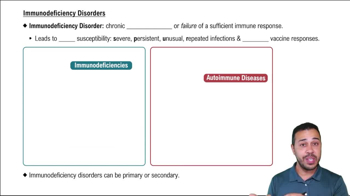
A chronic condition marked by insufficient immune response, resulting in increased vulnerability to infections and poor vaccine effectiveness.
Avanzamenti del tracciato
I pulsanti di controllo sono stati cambiati in modalità "navigazione".
1/15
Flashcard correlate
Pratica correlata
Video consigliati
Immunodeficiency Disorders quiz
Immunodeficiency Disorders
15 Termini
Transplantation
27. Immunological Disorders
3 Problemi
Argomento
27. Immunological Disorders - Part 1 of 2
4 Argomenti
11 Problemi
Capitolo
27. Immunological Disorders - Part 2 of 2
4 Argomenti
6 Problemi
Capitolo
02:41
Secondary Immunodeficiencies
118
views
4
rank
02:05
Immunodeficiency Disorders Example 1
114
views
3
rank
03:13
Immunodeficiency Disorders
138
views
3
rank
Termini in questo insieme (15)
Nascondere definizioni
Immunodeficiency
A chronic condition marked by insufficient immune response, resulting in increased vulnerability to infections and poor vaccine effectiveness.
Adaptive Immunity
A defense system involving specialized cells that target specific pathogens, often compromised in certain disorders.
Primary Immunodeficiency
A rare, congenital disorder caused by genetic defects, present from birth, affecting various immune system components.
Secondary Immunodeficiency
A common, acquired condition developing after birth due to factors like infections, aging, malnutrition, or medical treatments.
B Cells
Immune cells responsible for producing antibodies; their deficiency leads to increased infection risk.
T Cells
Immune cells essential for cell-mediated responses; their absence results in severe vulnerability to infections.
Phagocytes
Cells that engulf and destroy pathogens; defects here cause ineffective pathogen elimination and frequent infections.
Complement System
A group of proteins aiding immune defense; defects can impair pathogen clearance and increase infection susceptibility.
Bruton's Agammaglobulinemia
A genetic disorder causing lack of B cells and antibodies, leading to frequent and overwhelming infections.
DiGeorge Syndrome
A chromosomal deletion disorder resulting in impaired thymus development and severe T cell deficiency.
Chronic Granulomatous Disease
A genetic defect causing phagocytes to fail in producing chemicals needed to kill germs, resulting in severe infections.
AIDS
The advanced stage of HIV infection, marked by profound immune suppression and high risk of opportunistic infections.
HIV
A virus targeting and destroying helper T cells, leading to progressive immune system failure.
Opportunistic Infections
Infections by organisms that rarely cause disease in healthy individuals but thrive in weakened immune systems.
Immunosuppressant Drugs
Medications that intentionally weaken immune responses, often increasing susceptibility to infections.
 IndietroIndietro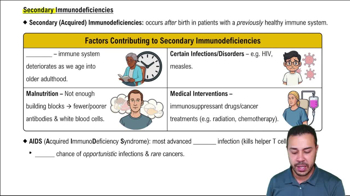
 02:41
02:41