Skip to main content
Microbiology
Il mio corso
Impara
Preparazione agli esami
AI Tutor
Guide di studio
Soluzioni per libri di testo
Flashcard
Esplora
Prova l'app
Il mio corso
Impara
Preparazione agli esami
AI Tutor
Guide di studio
Soluzioni per libri di testo
Flashcard
Esplora
Prova l'app
Indietro
Introduction to Biomolecules definitions
Puoi toccare per girare la carta.
Biomolecules
Puoi toccare per girare la carta.
👆
Biomolecules
Essential organic compounds with covalently linked hydrogen and carbon atoms, forming the foundation of living organisms.
Avanzamenti del tracciato
I pulsanti di controllo sono stati cambiati in modalità "navigazione".
1/14
Flashcard correlate
Pratica correlata
Video consigliati
Introduction to Biomolecules quiz
Introduction to Biomolecules
15 Termini
Introduction to Biomolecules
5. Molecules of Microbiology
3 Problemi
Argomento
Nicole
Monomers & Polymers
5. Molecules of Microbiology
4 Problemi
Argomento
Brendan
5. Molecules of Microbiology
8 Argomenti
14 Problemi
Capitolo
Nicole
01:17
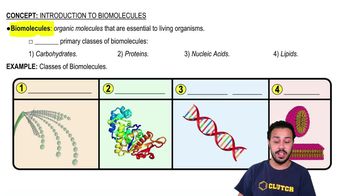
Introduction to Biomolecules
29226
views
612
rank
01:29
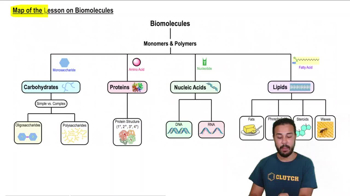
Map of the Lesson on Biomolecules
23941
views
790
rank
Termini in questo insieme (14)
Nascondere definizioni
Biomolecules
Essential organic compounds with covalently linked hydrogen and carbon atoms, forming the foundation of living organisms.
Carbohydrates
One of four main organic molecule classes, often visualized as the leftmost group, crucial for energy and structure in cells.
Proteins
A primary biomolecule class, represented visually and discussed for its structure and diverse roles in biological systems.
Nucleic Acids
A major biomolecule group, including DNA and RNA, responsible for storing and transmitting genetic information.
Lipids
A key biomolecule class, encompassing fats, phospholipids, steroids, and waxes, important for energy storage and membranes.
Monomers
Basic molecular units that serve as building blocks for larger, complex structures in biological systems.
Polymers
Large molecules formed by linking repeating smaller units, essential for constructing complex biomolecules.
Fats
A type of lipid, highlighted for its role in energy storage and as a structural component in organisms.
Phospholipids
A lipid subtype, noted for its importance in forming cellular membranes and contributing to cell structure.
Steroids
A lipid category, recognized for its structural diversity and role in signaling within biological systems.
Waxes
A lipid form, mentioned for its protective functions and presence in various biological surfaces.
DNA
A nucleic acid variant, central to genetic information storage and transmission in living organisms.
RNA
A nucleic acid type, compared with DNA, involved in genetic information transfer and protein synthesis.
Lesson Map
A visual guide outlining the sequence and structure of topics, aiding navigation through biomolecule content.
 IndietroIndietro
 01:17
01:17