Skip to main content
Microbiology
Il mio corso
Impara
Preparazione agli esami
AI Tutor
Guide di studio
Soluzioni per libri di testo
Flashcard
Esplora
Prova l'app
Il mio corso
Impara
Preparazione agli esami
AI Tutor
Guide di studio
Soluzioni per libri di testo
Flashcard
Esplora
Prova l'app
Indietro
Introduction to Water quiz
Puoi toccare per girare la carta.
What is the chemical formula for water?
Puoi toccare per girare la carta.
👆
What is the chemical formula for water?
The chemical formula for water is H2O, which means it has two hydrogen atoms and one oxygen atom.
Avanzamenti del tracciato
I pulsanti di controllo sono stati cambiati in modalità "navigazione".
1/15
Flashcard correlate
Pratica correlata
Video consigliati
Introduction to Water definitions
Introduction to Water
15 Termini
Introduction to Water
4. Water
3 Problemi
Argomento
Nicole
Properties of Water- Cohesion and Adhesion
4. Water
3 Problemi
Argomento
Monica
4. Water
7 Argomenti
14 Problemi
Capitolo
Nicole
01:54
Introduction to Water
23704
views
476
rank
01:51
Introduction to Water Example 1
17436
views
273
rank
01:29
Introduction to Water
20615
views
348
rank
Termini in questo insieme (15)
Nascondere definizioni
What is the chemical formula for water?
The chemical formula for water is H2O, which means it has two hydrogen atoms and one oxygen atom.
What type of bonds are found within a water molecule?
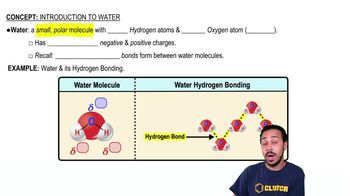
Water molecules contain polar covalent bonds between the hydrogen and oxygen atoms.
Why is water considered a polar molecule?
Water is polar because it has partial negative and partial positive charges due to unequal sharing of electrons between oxygen and hydrogen.
Which atom in a water molecule carries a partial negative charge?
The oxygen atom in a water molecule carries a partial negative charge.
What charge do the hydrogen atoms in water have?
The hydrogen atoms in water have partial positive charges.
What type of bond forms between different water molecules?
Hydrogen bonds form between different water molecules.
What enables water molecules to form hydrogen bonds with each other?
The partial positive and negative charges on water molecules enable them to form hydrogen bonds.
How many emergent properties of water are there that are essential for life?
There are four emergent properties of water that are essential for sustaining life on Earth.
What is the first emergent property of water mentioned in the lesson?
The first emergent property is water's ability to perform cohesion, adhesion, and to have surface tension.
How does water's density in solid form compare to its liquid form?
Water has a lower density in its solid (ice) form compared to its liquid form.
What is meant by water's high specific heat?
Water's high specific heat means it can absorb or release a large amount of heat with only a slight change in its own temperature.
What is the significance of water's high heat of vaporization?
Water's high heat of vaporization means it requires a lot of energy to change from liquid to gas, which helps regulate temperature.
Why is water called a universal solvent?
Water is called a universal solvent because it can dissolve many different substances, making it vital for biological processes.
What property allows water to stick to other substances?
Adhesion allows water to stick to other substances.
What property allows water molecules to stick to each other?
Cohesion allows water molecules to stick to each other.
 IndietroIndietro
 01:54
01:54