Skip to main content
Microbiology
Il mio corso
Impara
Preparazione agli esami
AI Tutor
Guide di studio
Soluzioni per libri di testo
Flashcard
Esplora
Prova l'app
Il mio corso
Impara
Preparazione agli esami
AI Tutor
Guide di studio
Soluzioni per libri di testo
Flashcard
Esplora
Prova l'app
Indietro
Isotopes definitions
Puoi toccare per girare la carta.
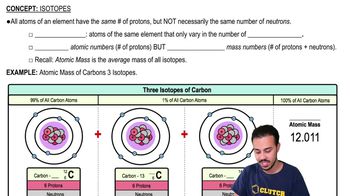
Isotope
Puoi toccare per girare la carta.
👆
Isotope
Atom of the same element with a different number of neutrons, resulting in a distinct mass number.
Avanzamenti del tracciato
I pulsanti di controllo sono stati cambiati in modalità "navigazione".
1/15
Flashcard correlate
Pratica correlata
Video consigliati
Isotopes quiz
Isotopes
15 Termini
Isotopes
3. Chemical Principles of Microbiology
4 Problemi
Argomento
Brendan
Introduction to Chemical Bonding
3. Chemical Principles of Microbiology
6 Problemi
Argomento
Brendan
3. Chemical Principles of Microbiology
7 Argomenti
12 Problemi
Capitolo
Nicole
06:50
Isotopes
29470
views
580
rank
02:37
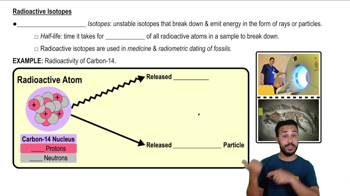
Radioactive Isotopes
20325
views
357
rank
Termini in questo insieme (15)
Nascondere definizioni
Isotope
Atom of the same element with a different number of neutrons, resulting in a distinct mass number.
Neutron
Neutral subatomic particle found in the nucleus, responsible for differences among isotopes of an element.
Proton
Positively charged subatomic particle in the nucleus; its count defines the element's identity.
Electron
Negatively charged subatomic particle orbiting the nucleus; its number matches protons in a neutral atom.
Atomic Number
Value representing the number of protons in an atom, uniquely identifying the element.
Mass Number
Sum of protons and neutrons in an atom's nucleus, distinguishing different isotopes.
Atomic Mass
Weighted average of all isotopes' masses for an element, reflecting their natural abundance.
Carbon-12
Most common carbon isotope, containing 6 protons and 6 neutrons, making up about 99% of carbon atoms.
Carbon-13
Stable carbon isotope with 6 protons and 7 neutrons, less abundant than the most common form.
Carbon-14
Radioactive carbon isotope with 6 protons and 8 neutrons, used in dating ancient biological materials.
Radioactive Isotope
Unstable atom variant that decays over time, emitting energy and particles from its nucleus.
Half-life
Time required for half the atoms in a radioactive sample to decay, used to estimate ages of materials.
Radiometric Dating
Technique using radioactive isotopes and their half-lives to determine the age of fossils or rocks.
Abundance
Proportion of a specific isotope present among all atoms of an element in nature.
Nucleus
Central region of an atom containing protons and neutrons, where mass and isotopic differences arise.
 IndietroIndietro
 06:50
06:50