Skip to main content
Microbiology
Il mio corso
Impara
Preparazione agli esami
AI Tutor
Guide di studio
Soluzioni per libri di testo
Flashcard
Esplora
Prova l'app
Il mio corso
Impara
Preparazione agli esami
AI Tutor
Guide di studio
Soluzioni per libri di testo
Flashcard
Esplora
Prova l'app
Indietro
Noncovalent Bonds quiz
Puoi toccare per girare la carta.
What is the main difference between covalent and noncovalent bonds?
Puoi toccare per girare la carta.
👆
What is the main difference between covalent and noncovalent bonds?
Covalent bonds involve sharing of electrons, while noncovalent bonds do not involve electron sharing.
Avanzamenti del tracciato
I pulsanti di controllo sono stati cambiati in modalità "navigazione".
1/15
Flashcard correlate
Pratica correlata
Video consigliati
Noncovalent Bonds definitions
Noncovalent Bonds
13 Termini
Noncovalent Bonds
3. Chemical Principles of Microbiology
3 Problemi
Argomento
Monica
Ionic Bonding
3. Chemical Principles of Microbiology
3 Problemi
Argomento
Nicole
3. Chemical Principles of Microbiology
7 Argomenti
12 Problemi
Capitolo
Nicole
03:14
Noncovalent Bonds
21884
views
307
rank
Termini in questo insieme (15)
Nascondere definizioni
What is the main difference between covalent and noncovalent bonds?
Covalent bonds involve sharing of electrons, while noncovalent bonds do not involve electron sharing.
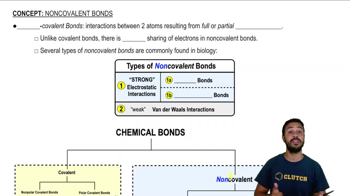
How are noncovalent bonds defined in terms of atomic interactions?
Noncovalent bonds are interactions between two atoms resulting from full or partial charges.
What are the two major groups of noncovalent bonds?
Noncovalent bonds are categorized into strong electrostatic interactions and weak Van Der Waals interactions.
Which group of noncovalent bonds will be the focus in biology courses?
Biology courses focus mainly on strong electrostatic interactions, specifically ionic and hydrogen bonds.
What types of strong electrostatic interactions are common in biology?
The two types are ionic bonds and hydrogen bonds.
Will weak Van Der Waals interactions be covered in this biology course?
No, weak Van Der Waals interactions will be covered more extensively in chemistry courses.
What does the term 'covalent' refer to in chemical bonding?
Covalent refers to the sharing of electrons between atoms.
What does adding 'non' in front of 'covalent' indicate about electron sharing?
It indicates that there is no sharing of electrons in noncovalent bonds.
What is the next topic after covalent bonds in the lesson map?
The next topic is noncovalent bonds.
Which two types of covalent bonds were previously discussed?
Nonpolar covalent and polar covalent bonds were previously discussed.
What is the first type of strong electrostatic interaction to be discussed in future lessons?
Ionic bonds will be discussed first.
After ionic bonds, which type of bond will be discussed?
Hydrogen bonds will be discussed after ionic bonds.
What is the main characteristic of noncovalent bonds regarding electron sharing?
Noncovalent bonds do not involve sharing of electrons.
Where will students learn more about weak Van Der Waals interactions?
Students will learn more about weak Van Der Waals interactions in chemistry courses.
What is the focus of the biology course regarding noncovalent bonds?
The focus is on strong electrostatic interactions, specifically ionic and hydrogen bonds.
 IndietroIndietro
 03:14
03:14