Skip to main content
Microbiology
Il mio corso
Impara
Preparazione agli esami
AI Tutor
Guide di studio
Soluzioni per libri di testo
Flashcard
Esplora
Prova l'app
Il mio corso
Impara
Preparazione agli esami
AI Tutor
Guide di studio
Soluzioni per libri di testo
Flashcard
Esplora
Prova l'app
Indietro
Pneumonia definitions
Puoi toccare per girare la carta.
Alveoli
Puoi toccare per girare la carta.
👆
Alveoli
Tiny air sacs in the lungs where gas exchange occurs and which can fill with fluid during infection, leading to impaired breathing.
Avanzamenti del tracciato
I pulsanti di controllo sono stati cambiati in modalità "navigazione".
1/15
Flashcard correlate
Pratica correlata
Video consigliati
Pneumonia quiz
Pneumonia
15 Termini
Pneumonia
30. Microbial Infections - Respiratory System
4 Problemi
Argomento
30. Microbial Infections - Respiratory System
3 Argomenti
7 Problemi
Capitolo
VideoThumbView.guidedCourse
06:07
Pneumococcal Pneumonia
175
views
3
rank
VideoThumbView.guidedCourse
04:23
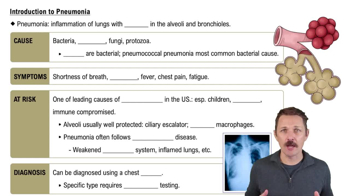
Introduction to Pneumonia
201
views
5
rank
Termini in questo insieme (15)
Nascondere definizioni
Alveoli
Tiny air sacs in the lungs where gas exchange occurs and which can fill with fluid during infection, leading to impaired breathing.
Streptococcus pneumoniae
A gram-positive, lancet-shaped diplococcus bacterium with a polysaccharide capsule, commonly causing bacterial lung infections.
Polysaccharide capsule
A protective outer layer surrounding certain bacteria, enhancing their ability to evade immune cells and increasing disease severity.
Phagocytosis
A process by which immune cells engulf and destroy pathogens, often hindered by bacterial capsules in lung infections.
Diplococci
Pairs of spherical bacteria, often seen in gram stains of pneumococcal infections, with a characteristic lancet shape.
Consolidation
A condition where lung tissue becomes firm and airless due to fluid accumulation, visible on chest x-rays during infection.
Chest x-ray
An imaging technique used to detect fluid-filled areas in the lungs, aiding in the diagnosis of respiratory infections.
Sputum smear
A laboratory test involving the microscopic examination of coughed-up fluid to identify causative bacteria in lung infections.
Beta-lactam antibiotics
A class of drugs, including penicillin and cephalosporins, commonly used as first-line treatment for gram-positive bacterial infections.
Pneumococcal conjugate vaccine
An immunization designed to protect against severe lung infections, especially in children and the elderly, by targeting bacterial capsules.
Ciliary escalator
A defense mechanism in the respiratory tract that moves particles and microbes upward, helping prevent lower lung infections.
Alveolar macrophages
Immune cells residing in lung air sacs, responsible for engulfing and removing pathogens that reach deep respiratory areas.
Respiratory droplets
Tiny particles expelled during coughing or sneezing, serving as a primary mode of transmission for lung infections.
Rust-colored sputum
A distinctive symptom of certain lung infections, where coughed-up fluid appears reddish-brown due to minor bleeding and inflammation.
Immune compromised
A state in which the body's defenses are weakened, increasing susceptibility to severe respiratory infections and complications.
 IndietroIndietro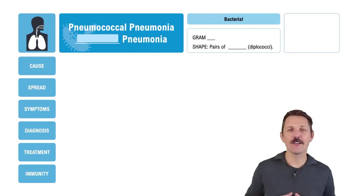
 06:07
06:07