Skip to main content
Microbiology
Il mio corso
Impara
Preparazione agli esami
AI Tutor
Guide di studio
Soluzioni per libri di testo
Flashcard
Esplora
Prova l'app
Il mio corso
Impara
Preparazione agli esami
AI Tutor
Guide di studio
Soluzioni per libri di testo
Flashcard
Esplora
Prova l'app
Indietro
The Steps of PCR quiz
Puoi toccare per girare la carta.
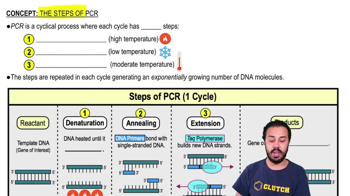
What are the three main steps of each PCR cycle?
Puoi toccare per girare la carta.
👆
What are the three main steps of each PCR cycle?
The three main steps are denaturation, annealing, and extension.
Avanzamenti del tracciato
I pulsanti di controllo sono stati cambiati in modalità "navigazione".
1/15
Flashcard correlate
Pratica correlata
Video consigliati
The Steps of PCR definitions
The Steps of PCR
15 Termini
The Steps of PCR
17. Biotechnology
4 Problemi
Argomento
Brendan
Gel Electrophoresis
17. Biotechnology
3 Problemi
Argomento
Nicole
17. Biotechnology
10 Argomenti
14 Problemi
Capitolo
Brendan
03:33
1) Denaturation
5295
views
50
rank
1
comments
02:56
2) Annealing
5127
views
47
rank
04:39
The Steps of PCR
6595
views
44
rank
Termini in questo insieme (15)
Nascondere definizioni
What are the three main steps of each PCR cycle?
The three main steps are denaturation, annealing, and extension.
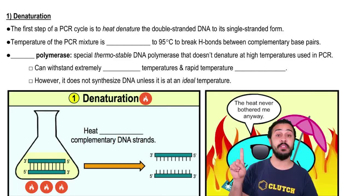
At what temperature does the denaturation step of PCR occur?
Denaturation occurs at about 95 degrees Celsius.
What happens to DNA during the denaturation step of PCR?
The double-stranded DNA is separated into single strands by breaking hydrogen bonds.
Why is Taq polymerase used in PCR?
Taq polymerase is thermostable and does not denature at the high temperatures used in PCR.
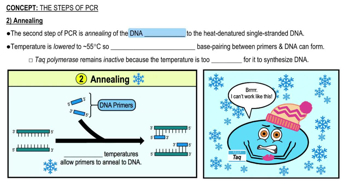
What is the purpose of the annealing step in PCR?
Annealing allows DNA primers to bind to the single-stranded DNA through complementary base pairing.
At what temperature does the annealing step of PCR occur?
Annealing occurs at about 55 degrees Celsius.
Is Taq polymerase active during the annealing step of PCR?
No, Taq polymerase remains inactive at the cooler temperature of the annealing step.
What happens during the extension step of PCR?
Taq polymerase extends the DNA primers by adding nucleotides to synthesize new DNA strands.
At what temperature does the extension step of PCR occur?
Extension occurs at about 72 degrees Celsius, which is optimal for Taq polymerase activity.
What direction does Taq polymerase extend the DNA primers during PCR?
Taq polymerase extends the primers in the 5' to 3' direction.
What is the result of one cycle of PCR?
One cycle produces two identical copies of the original DNA template.
How does PCR achieve exponential amplification of DNA?
Each cycle uses the products of the previous cycle as templates, doubling the DNA amount each time.
What components must be present in the PCR reaction mixture?
The mixture must contain template DNA, DNA primers, Taq polymerase, and DNA nucleotides.
What is the role of DNA primers in PCR?
DNA primers bind to the single-stranded DNA and provide a starting point for Taq polymerase to extend.
Why is it important that Taq polymerase is thermostable in PCR?
It must withstand the high temperatures of denaturation and remain functional for DNA synthesis.
 IndietroIndietro
 03:33
03:33