 Indietro
Bacterial Cell Walls in Microbiology
 01:58
01:58
Termini in questo insieme (20)
Prevents osmotic lysis and contributes to pathogenicity.
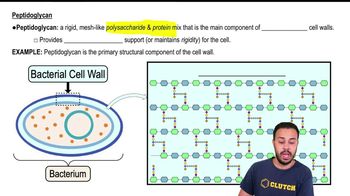
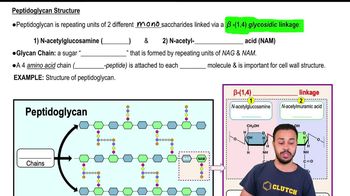
Peptidoglycan, a polymer of repeating disaccharides N-acetylglucosamine (NAG) and N-acetylmuramic acid (NAM).
Rows of NAG and NAM linked by polypeptides forming a lattice structure.
Interferes with the formation of peptide cross-bridges in peptidoglycan.
Alcohol dehydrates thick peptidoglycan, trapping crystal violet-iodine (CV-I) crystals, staining cells purple.
Alcohol dissolves outer membrane and washes out CV-I crystals; cells are counterstained pink with safranin.
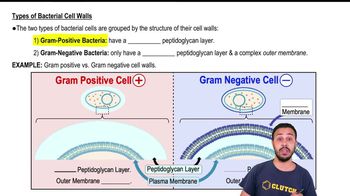
Thick peptidoglycan layers with teichoic acids linking to plasma membrane and peptidoglycan; negatively charged.
Link cell wall to plasma membrane and peptidoglycan; contribute to negative charge.
Highly susceptible to penicillin and lysozyme.
Thin peptidoglycan in periplasmic space and an outer membrane made of LPS, lipoproteins, and phospholipids.
Contains LPS (O polysaccharide antigen and Lipid A endotoxin), protects from phagocytes, complement, and antibiotics.
Porins are proteins that form channels allowing molecules to pass through the outer membrane.
Produce both endotoxins (Lipid A) and exotoxins.
Low susceptibility due to protective outer membrane.
Thick peptidoglycan with mycolic acid (waxy lipid) bound; stain with carbolfuchsin which resists acid-alcohol decolorization.
Mycobacterium and Nocardia.
Lack cell walls; have sterols in plasma membrane that protect from lysis.
Either wall-less or have walls made of pseudomurein, which lacks NAM and D-amino acids.
Digests portions of peptidoglycan, weakening the cell wall.
Inhibits formation of peptide bridges in peptidoglycan, preventing proper cell wall synthesis.