 Indietro
Chapter 1
 03:36
03:36

Termini in questo insieme (26)
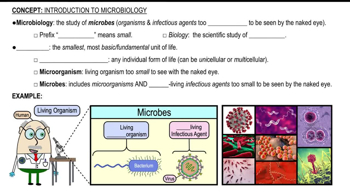
microorganisms and non-living infectious agents too small to be seen with the naked eye.
smallest, basic, and fundamental unit of life.
living organism, uni- or multicellular, too small to be seen with the naked eye, containing DNA as genetic material.
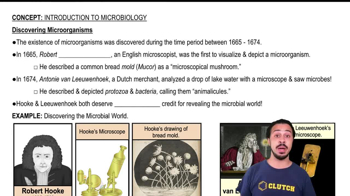
First visualization of microorganisms, mold
Robert Hooke
Bacteria (prokaryotic), Archaea (prokaryotic), and Eukarya (eukaryotic).
Bacteria are unicellular prokaryotes with cell walls made of peptidoglycan and reproduce by binary fission.
Archaea are prokaryotes with unique ribosomal RNA, lack peptidoglycan, and often live in extreme environments.
Eukarya have membrane-bound nuclei and include unicellular or multicellular organisms like animals, plants, fungi, and protists.
The four kingdoms are Animalia, Plantae, Fungi, and Protista.
Genus is capitalized and species is lowercase; both are italicized or underlined, e.g., Borrelia burgdorferi.
Viruses are acellular obligate intracellular parasites made of DNA or RNA inside a protein coat; they require a host to replicate.
Viroids are small, circular RNA strands that infect plants and cause disease.
Prions are infectious proteins that cause normal proteins to misfold, leading to degenerative diseases.
Binary fission is the process by which bacteria reproduce by copying DNA and splitting into two identical daughter cells.
Human microbiota are communities of microorganisms normally living on and in the human body without causing harm.
Normal microbiota compete with disease-causing microbes and play a role in human health.
Organisms can be producers (autotrophs) making their own food or consumers (heterotrophs) acquiring energy by eating others.
Fungi are multicellular or unicellular eukaryotes with chitin cell walls that acquire energy from organic materials.
Protists are unicellular or multicellular eukaryotes, including algae (photosynthetic) and protozoa (non-photosynthetic).
Microorganisms are essential for food production, antibiotics, nitrogen fixation, bioremediation, and as model organisms in research.
Eukaryotic motility structures include flagella (long whip-like tails), cilia (short hairs), and pseudopods (cytoplasmic extensions).
All organisms are made of cells, maintain homeostasis, and evolved from a common ancestor.
Organisms like viruses that can only replicate inside a host cell are called obligate intracellular parasites.
Methanogens are archaea that produce methane as a waste product of respiration.
Halophiles thrive in high salt; thermophiles thrive in high temperature environments.
Negative control prevents false positives; positive control ensures the experiment can produce a positive result.