 Indietro
Exam 1
 02:17
02:17
Termini in questo insieme (25)
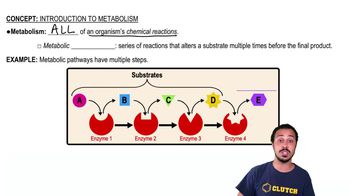
Metabolism is the collection of controlled biochemical reactions within a microbe, ultimately functioning to reproduce the organism.
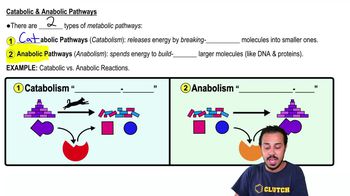
Catabolic pathways break down molecules and release energy (exergonic). Anabolic pathways synthesize molecules and require energy (endergonic).
ATP (adenosine triphosphate) stores and transfers energy within cells.
Glycolysis is the splitting of glucose into two pyruvic acid molecules, occurring in the cytoplasm of most cells.
Direct transfer of a phosphate group between substrates to form ATP during glycolysis and Krebs cycle.
Energy-investment stage, lysis stage, and energy-conserving stage.
Glucose is phosphorylated twice by ATP to form fructose 1,6-bisphosphate.
2 ATP molecules and 2 NADH molecules per glucose molecule.
Decarboxylates pyruvic acid to acetate, produces CO2 and NADH, and forms acetyl-CoA with a high-energy bond.
Occurs in the cytosol of prokaryotes and mitochondrial matrix in eukaryotes; fully oxidizes acetyl-CoA to CO2 and transfers energy to NADH and FADH2.
Anabolism of citric acid, isomerization, decarboxylation, redox reactions, substrate-level phosphorylation, and hydration.
2 ATP, 6 NADH, 2 FADH2, and 4 CO2 molecules.
A series of membrane-bound carriers that transfer electrons to a final acceptor, pumping protons to create a gradient for ATP synthesis.
Oxygen, which is reduced to water.
Proton gradient drives ATP synthase to phosphorylate ADP to ATP, a process called oxidative phosphorylation.
Approximately 38 ATP in prokaryotes and 36 ATP in eukaryotes.
Entner-Doudoroff pathway and Pentose Phosphate pathway, producing different precursor metabolites and NADPH.
Partial oxidation of sugars to regenerate NAD+ when respiration is not possible, producing organic waste products.
Fermentation uses organic molecules as final electron acceptors and produces less ATP; anaerobic respiration uses inorganic molecules other than oxygen.
Lipids are hydrolyzed into glycerol and fatty acids; glycerol enters glycolysis, fatty acids undergo beta-oxidation to form acetyl-CoA.
\((\frac{N}{2}-1) \times 5 + (\frac{N}{2} \times 12)\), where N is the number of carbons.
Proteins are broken down extracellularly into amino acids, transported into the cell, and deaminated to enter the Krebs cycle.
Synthesis of carbohydrates, lipids, amino acids, and nucleotides using energy from ATP and precursor metabolites.
Synthesis of sugars from non-carbohydrate precursors like fats and proteins, often reversing glycolysis steps.
By controlling enzyme production (gene expression) and enzyme activity (allosteric regulation, feedback inhibition).