Skip to main content
Microbiology
Il mio corso
Impara
Preparazione agli esami
AI Tutor
Guide di studio
Soluzioni per libri di testo
Flashcard
Esplora
Prova l'app
Il mio corso
Impara
Preparazione agli esami
AI Tutor
Guide di studio
Soluzioni per libri di testo
Flashcard
Esplora
Prova l'app
Indietro
Exam 1
Puoi toccare per girare la carta.
What are the two main sources of carbon for microbes?
Puoi toccare per girare la carta.
👆
What are the two main sources of carbon for microbes?
Autotrophs
use CO2 as a carbon source, while
heterotrophs
use organic compounds from other organisms.
Avanzamenti del tracciato
I pulsanti di controllo sono stati cambiati in modalità "navigazione".
1/24
Video consigliati
04:16
Temperature Requirements for Microbial Growth
3584
views
48
rank
04:56
Classification of Microbes by Growth Temperature
3341
views
44
rank
01:59
How to Memorize the Classification of Microbes by Growth Temperatures
2988
views
32
rank
Termini in questo insieme (24)
Nascondere definizioni
What are the two main sources of carbon for microbes?
Autotrophs
use CO2 as a carbon source, while
heterotrophs
use organic compounds from other organisms.
How do microbes acquire energy?
Microbes are
chemotrophs
if they use chemicals and
phototrophs
if they use light as their energy source.
What are organotrophs and lithotrophs?
Organotrophs
use organic molecules as electron sources, while
lithotrophs
use inorganic molecules.
What is the difference between obligate aerobes and obligate anaerobes?
Obligate aerobes
require oxygen
for growth, while obligate anaerobes are
killed by oxygen
.
Name four toxic forms of oxygen that can damage cells.
Singlet oxygen (1O2), superoxide radicals (O2−), peroxide anion (O22-), and hydroxyl radical (OH·).
Which enzymes detoxify reactive oxygen species (ROS)?
Superoxide dismutase
,
catalase
, and
peroxidase
detoxify ROS by converting them to less harmful molecules.
What are facultative aerobes?
Organisms that can grow with or without oxygen but generally prefer oxygen for aerobic respiration.
What is nitrogen fixation and why is it important?
Conversion of atmospheric N2 to ammonia (NH3) by certain bacteria; essential for making nitrogen available for biosynthesis.
Why are trace elements important for microbial growth?
Trace elements act as enzyme cofactors and are required in small amounts for anabolic pathways.
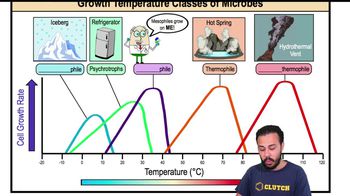
How does temperature affect microbial growth?
Temperature influences protein and membrane structure; microbes have an optimum growth temperature range.
Define psychrophiles, mesophiles, and thermophiles.
Psychrophiles grow best below 15°C, mesophiles between 20-40°C, and thermophiles above 45°C.
How does pH affect microbial growth?
pH affects protein and nucleic acid folding; microbes are classified as neutrophiles, acidophiles, or alkalinophiles based on pH preference.
What is osmotic pressure and how does it affect microbes?
Pressure from solutes on a semipermeable membrane; hypotonic causes swelling, hypertonic causes shrinking of cells.
What are halophiles?
Salt-loving microbes that require moderate to high salt concentrations for growth.
What is quorum sensing?
Bacterial communication system where cells detect population density via signaling molecules to regulate gene expression.
Describe binary fission.
A form of asexual reproduction where one cell divides into two genetically identical daughter cells.
How is generation time calculated?
Generation time (G) = time interval (t) divided by number of generations (n), \(G=\frac{t}{n}\).
How do you calculate the total number of cells after n generations?
Total cells = initial cells (b) × 2^n, \(B=b \times 2^n\).
What are the phases of microbial growth in batch culture?
Lag phase, log (exponential) phase, stationary phase, and death (decline) phase.
What is a chemostat?
A continuous culture system that maintains microbial populations in a specific growth phase by adding fresh medium and removing old.
Name two direct methods to count microbial cells without incubation.
Electronic counters like Coulter counters and flow cytometry.
What is the viable plate count method?
A direct counting method using serial dilutions and plating to count colony-forming units (CFUs) after incubation.
What is the most probable number (MPN) method?
A statistical method estimating bacterial concentration based on dilution series and growth in multiple tubes.
How does turbidity estimate microbial population size?
Indirect method measuring culture cloudiness with a spectrophotometer; more turbidity indicates higher cell density.
 IndietroIndietro
 04:16
04:16