 Indietro
Introduction to Microbiology
 03:36
03:36

Termini in questo insieme (21)
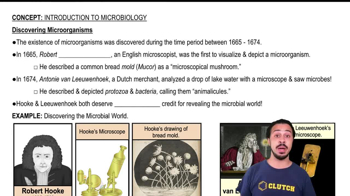
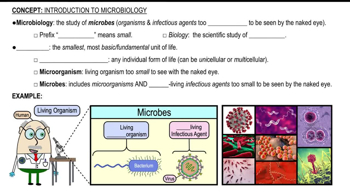
Microbiology is the study of microorganisms or microbes, which are often invisible to the naked eye.
Microbes include cellular living microorganisms like bacteria, archaea, fungi, protists, helminths, and nonliving entities such as viruses and prions.
Prokaryotic cells lack a nucleus and include bacteria and archaea. Eukaryotic cells have a nucleus and include fungi, protists, and multicellular organisms.
Pathogens always cause disease in humans, while opportunistic pathogens cause disease only in weakened hosts.
Spontaneous generation is the disproven theory that life arises from nonliving matter. Biogenesis states life arises from existing life.
Louis Pasteur disproved spontaneous generation using an S-necked flask experiment showing that air contains microbes but they do not spontaneously generate.
The germ theory of disease states that microbes cause infectious diseases.
Four criteria to link a microbe to a disease: 1) Present in every case, 2) Isolated and grown in pure culture, 3) Causes disease in a healthy host, 4) Re-isolated from the infected host.
Semmelweis promoted hand washing to reduce infections, Lister introduced aseptic surgery techniques, and Nightingale established aseptic nursing practices.
Aseptic technique prevents contamination and healthcare-acquired infections by practices like hand washing, sterilizing instruments, and decontaminating surfaces.
It involves asking a question, proposing a hypothesis, collecting data through observation, and drawing conclusions to support or refute the hypothesis.
An observation is data collected using senses or instruments; a conclusion interprets observations to explain findings.
Laws predict what happens, often as precise statements or formulas; theories explain how and why phenomena occur, supported by extensive evidence.
Taxonomy is the classification of organisms based on shared features, including morphology and physiology.
Domain, Kingdom, Phylum, Class, Order, Family, Genus, Species.
Bacteria (unicellular prokaryotes), Archaea (extremophilic prokaryotes, no known pathogens), and Eukarya (unicellular and multicellular eukaryotes).
A two-name system for naming organisms: the genus name (capitalized) and species name (lowercase), both italicized, e.g., Escherichia coli.
Microbes that normally live on or in the human body, including bacteria, archaea, and eukaryotic microbes, which help train the immune system and aid digestion.
Microbes colonize babies during delivery and early life through environmental exposure, influenced by delivery mode and feeding type.
Disruption, such as by antibiotics, can reduce protective microbes and allow opportunistic pathogens to cause infections.
Temporary microbes acquired from the environment that do not persist and can be removed by hygiene practices like hand washing.