 Indietro
Introduction to Microbiology
 03:36
03:36

Termini in questo insieme (23)
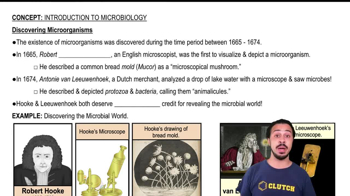
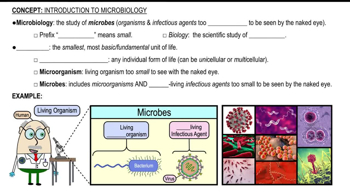
Microbiology is the study of microorganisms or microbes, including cellular living forms like bacteria, archaea, fungi, protists, helminths, and nonliving entities like viruses and prions.
Prokaryotic cells are unicellular and lack a nucleus (e.g., bacteria, archaea). Eukaryotic cells have a nucleus and can be unicellular or multicellular (e.g., fungi, protists, helminths).
Prions are infectious proteins, nonliving, discovered in the 1980s, transmitted by transplant or ingestion, and can cause inherited diseases.
Spontaneous generation is the disproven theory that life arises from nonliving matter.
Biogenesis is the principle that life arises from existing life, demonstrated by Louis Pasteur.
Disproved spontaneous generation, developed pasteurization, and created vaccines for anthrax and rabies.
The theory that microbes cause infectious diseases, established by Robert Koch.
- Same organism present in every disease case
- Isolate organism in pure culture
- Inoculate susceptible host to cause disease
- Re-isolate organism from diseased host
Practices to prevent contamination by microbes, such as hand washing, sterilizing instruments, and decontaminating surfaces.
Introduced hand washing in hospitals to reduce mortality from childbed fever.
Proved sterilizing instruments and sanitizing wounds with carbolic acid prevents infections in surgery.
The study of classifying organisms by shared features like morphology and physiology.
Domain, Kingdom, Phylum, Class, Order, Family, Genus, Species.
Bacteria (unicellular prokaryotes), Archaea (prokaryotes in extreme environments), and Eukarya (unicellular and multicellular eukaryotes).
A two-name system for naming species: Genus (capitalized) and species (lowercase), both italicized (e.g., Escherichia coli).
Pathogens always cause disease; opportunistic pathogens cause disease only in weakened hosts.
A sticky community of microbes on surfaces, resistant to antibiotics and immune responses, causing many infections.
Mutualism: both benefit
Commensalism: one benefits, other unaffected
Parasitism: one benefits, other harmed
Microbes living on and in the human body that help train the immune system, produce vitamins, and protect against pathogens.
Antibiotics can reduce normal flora, allowing opportunistic pathogens like Candida albicans to cause infections.
To characterize all microbes living in and on the human body.
Example: Sickle cell gene mutation provides resistance to malaria, showing coevolution of humans and microbes.
Use of microbes to metabolize toxic substances into harmless compounds to clean up environmental waste.