 Indietro
Introduction to Microbiology - Key Concepts
 03:36
03:36

Termini in questo insieme (25)
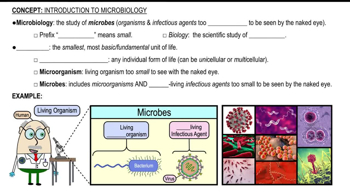
Microbiology is the study of microorganisms or microbes, which are often too small to be seen with the naked eye. It includes cellular microbes like bacteria, archaea, fungi, protists, helminths, and noncellular entities like viruses and prions.
Prokaryotic cells are unicellular organisms without a nucleus (e.g., bacteria and archaea). Eukaryotic cells have a nucleus and can be unicellular or multicellular (e.g., fungi, protists, plants, animals).
Viruses are nonliving, noncellular infectious agents with DNA or RNA genomes that infect cells. Prions are infectious proteins that cause disease and are not cells.
Biogenesis is the principle that life arises from existing life. Louis Pasteur disproved spontaneous generation and proved biogenesis using his S-neck flask experiment.
Spontaneous generation is the disproven theory that life arises from nonliving matter, such as maggots arising from rotting meat.
Four criteria to link a microbe to a disease: 1) Microbe present in all disease cases, 2) Isolated and grown in pure culture, 3) Causes disease when inoculated into healthy host, 4) Re-isolated from inoculated host.
The germ theory states that microbes cause infectious diseases. Robert Koch helped establish this theory by identifying specific pathogens.
Semmelweis introduced hand washing to reduce infections, Lister developed aseptic surgical techniques, and Nightingale established aseptic nursing practices.
The scientific method involves making observations, proposing a hypothesis, collecting and analyzing data, and drawing conclusions to support or refute the hypothesis.
Taxonomy is the classification of organisms. The hierarchy is Domain, Kingdom, Phylum, Class, Order, Family, Genus, Species.
The three domains are Bacteria (unicellular prokaryotes), Archaea (unicellular prokaryotes in extreme environments), and Eukarya (unicellular and multicellular eukaryotes).
A two-name system for naming organisms: the genus name (capitalized) and species name (lowercase), both italicized, e.g., Escherichia coli.
Interactions between microbes and hosts: parasitism (harm host), mutualism (benefit host), and commensalism (no benefit or harm).
The human microbiome is the collection of microbes living in and on the human body, important for immune training, vitamin production, digestion, and possibly mood regulation.
Normal microbiota colonize humans during birth and early life, influenced by delivery mode, feeding, and environment, and evolve throughout life.
Biofilms are sticky microbial communities attached to surfaces, protected by a matrix, often resistant to antibiotics and immune responses.
Aseptic technique involves practices like hand washing, sterilizing instruments, and decontaminating surfaces to prevent contamination and healthcare-associated infections.
Culture media are nutrient mixtures used to grow microbes in the lab, available as broths, plates, slants, and deeps.
The streak plate technique isolates individual microbial colonies by spreading a sample over an agar plate to obtain pure cultures.
The Gram stain differentiates bacteria into Gram-positive (purple, thick peptidoglycan) and Gram-negative (pink, thin peptidoglycan with outer membrane) based on cell wall structure.
Acid-fast staining identifies bacteria with waxy mycolic acid cell walls, such as Mycobacterium, which retain red dye after acid wash.
Resolution is the ability to distinguish two points as separate; higher resolution reveals finer details in microscopy.
Immersion oil has the same refractive index as glass, reducing light refraction and improving image clarity at high magnifications.
Light microscopy uses visible light, is simpler and cheaper, and can view live specimens. Electron microscopy uses electron beams, offers higher magnification and resolution, but requires dead, stained samples.
Fluorescence microscopy uses UV light to excite fluorochromes that emit visible light, allowing sensitive detection of specific molecules or microbes.