 Indietro
Microbial Metabolism and Enzymes
 02:17
02:17
Termini in questo insieme (21)
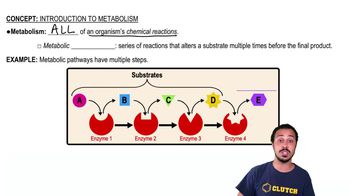
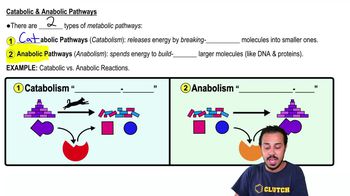
Metabolism is the sum of all chemical reactions in a cell, including catabolism and anabolism.
Catabolism releases energy by breaking down molecules, storing energy as ATP.
Anabolism uses energy from ATP to synthesize macromolecules needed by the cell.
ATP stores energy released by catabolism and supplies energy for anabolic reactions.
Enzymes are biological catalysts that speed up chemical reactions by lowering activation energy without being permanently changed.
The active site is the specific region on an enzyme where substrate molecules bind.
A holoenzyme consists of an apoenzyme (protein part) plus its cofactor (nonprotein helper).
Cofactors are nonprotein enzyme helpers; organic cofactors are called coenzymes, e.g., NAD+ and FAD.
Enzymes usually end in ase and are named based on the reaction type or substrate involved.
Exoenzymes are secreted outside the cell to break down large molecules; endoenzymes function inside the cell.
Increasing temperature speeds reactions up to an optimum point; high temperatures cause enzyme denaturation and loss of function.
Each enzyme has an optimum pH; extreme acidic or basic conditions denature enzymes and reduce activity.
Increasing substrate concentration increases reaction rate until all enzyme active sites are saturated, reaching maximum velocity.
Competitive inhibitors bind the active site; noncompetitive inhibitors bind elsewhere, changing enzyme shape and function.
Feedback inhibition is when the end product of a pathway binds an enzyme to shut down the pathway, regulating metabolism.
Oxidation is loss of electrons or hydrogens; reduction is gain of electrons or hydrogens; these paired reactions are called redox reactions.
Glycolysis breaks down glucose into 2 pyruvic acids, producing 2 net ATP and 2 NADH molecules.
Pyruvic acid is converted to acetyl CoA, producing 1 CO2 and 1 NADH per pyruvate, preparing for the Krebs cycle.
The Krebs cycle produces 1 ATP, 3 NADH, 1 FADH2, and 2 CO2 per acetyl CoA molecule.
Electrons from NADH and FADH2 pass through the chain, pumping protons to create a gradient used by ATP synthase to generate ATP by chemiosmosis.
Fermentation regenerates NAD+ from NADH without oxygen, producing 2 ATP per glucose and various organic end products.