 Indietro
Microbiology: Bacterial and Archaeal Growth
 02:16
02:16
Termini in questo insieme (28)
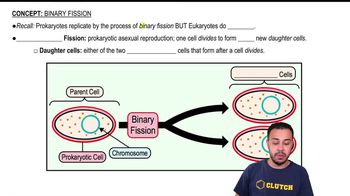
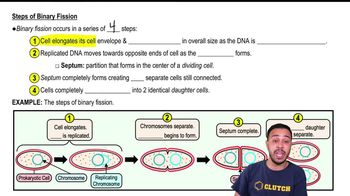
Binary fission is the primary asexual reproductive method in bacteria and archaea, involving replication of the single circular chromosome and division into two daughter cells.
Three phases: 1) Growth after cell birth, 2) Chromosome replication and partitioning, 3) Cytokinesis with septum formation.
The DNA synthesis machinery that copies the double-stranded circular chromosome during replication.
The Z-ring is formed by polymerization of FtsZ protein at the future division site, initiating cytokinesis and septum formation.
The Min system prevents Z-ring formation at cell poles, while nucleoid occlusion prevents Z-ring formation over unsegregated chromosomes.
A protein complex anchored by FtsA and ZipA that synthesizes and remodels the cell wall during division.
1) NAG-NAM-pentapeptide synthesized on bactoprenol, 2) MurJ flips it across membrane, 3) Glycosyltransferases insert it into peptidoglycan, crosslinked by transpeptidases.
Peptidoglycan synthesis occurs only at the central septum, guided by FtsZ localization.
Elongasome complex with MreB scaffold directs peptidoglycan synthesis along the sidewall; MreB depletion leads to spherical shape.
Crescentin protein localizes asymmetrically, causing curved cell shape by uneven cell wall synthesis.
Similar to eukaryotic mitotic cycle with G1, S, G2 phases, chromosome segregation, and cytokinesis, but with a single circular chromosome.
Lag phase, exponential (log) phase, stationary phase, death phase, and long-term stationary phase.
Cells synthesize new components to adapt to new conditions before starting division.
Cells divide at a constant maximal rate; population is most uniform chemically and physically.
Growth ceases due to nutrient limitation or waste accumulation; cell division balances cell death.
Viable cell number declines exponentially due to nutrient deprivation and toxic waste buildup.
Time required for a microbial population to double in size; varies by species and environment.
Number of generations per unit time; related to generation time by \(g=\frac{1}{k}\).
Include osmotic pressure, pH, temperature, oxygen concentration, pressure, and radiation.
Obligate aerobes, obligate anaerobes, microaerophiles, facultative anaerobes, and aerotolerant anaerobes.
Superoxide dismutase, catalase, and peroxidase protect aerobes from toxic oxygen derivatives.
Surface-attached microbial communities embedded in extracellular polymeric substances, providing protection and complex interactions.
Cell-cell communication mechanism where bacteria detect population density via signaling molecules to regulate gene expression.
Defined (synthetic), complex, supportive, enriched, selective, and differential media used to grow and isolate microbes.
Techniques like streak plate, spread plate, and pour plate separate individual cells to obtain pure microbial cultures.
Counting chambers, membrane filter technique, flow cytometry, and electronic counters measure microbial population size.
Standard plate counts and membrane filter methods count colony-forming units (CFUs) to estimate viable cells.
Chemostats and turbidostats maintain microbial populations in exponential growth by controlling nutrient supply and waste removal.