Indietro

Microbiology Basics and Microbial Interactions

I pulsanti di controllo sono stati cambiati in modalità "navigazione".
1/21
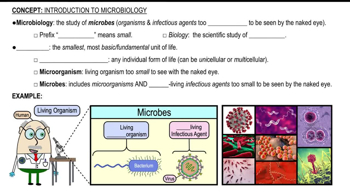
  • Are viruses cells?

    No.

  • Are viruses living organisms?

    No.

  • What do viruses need to reproduce?

    A host cell.

  • What is a prion?

    An infectious protein.

  • Is a prion a cell?

    No.

  • Is “microscopic living organism” a perfect definition of a microbe?

    No. Some microbes are non-cellular.

  • What are the 2 main cell types?

    Prokaryotic and eukaryotic.

  • Do prokaryotes have a nucleus?

    No.

  • Do eukaryotes have a nucleus?

    Yes.

  • Which cells are usually smaller?

    Prokaryotes.

  • How are microbes named in binomial naming?

    Genus + species.

  • Which name comes first in binomial naming?

    Genus.

  • Is the genus capitalized in binomial naming?

    Yes.

  • Is the species capitalized in binomial naming?

    No.

  • What is a microbiome?

    Microbes living in an environment.

  • What is mutualism?

    Both organisms benefit.

  • What is commensalism?

    One benefits; the other is unaffected.

  • What is parasitism?

    One benefits; the other is harmed.

  • Which interactions are common in a healthy microbiome?

    Mutualism and commensalism.

  • What sequence-similarity cutoff is mentioned for microbial grouping?

    97%.

  • What problem can a 97% sequence-similarity cutoff cause?

    Different microbes can be grouped together incorrectly.