Skip to main content
Microbiology
Il mio corso
Impara
Preparazione agli esami
AI Tutor
Guide di studio
Soluzioni per libri di testo
Flashcard
Esplora
Prova l'app
Il mio corso
Impara
Preparazione agli esami
AI Tutor
Guide di studio
Soluzioni per libri di testo
Flashcard
Esplora
Prova l'app
Indietro
Microbiology: Biochemistry Basics
Puoi toccare per girare la carta.
What is an atom?
Puoi toccare per girare la carta.
👆
What is an atom?
An atom is the smallest unit of an element, consisting of a nucleus with protons and neutrons, surrounded by electrons.
Avanzamenti del tracciato
I pulsanti di controllo sono stati cambiati in modalità "navigazione".
1/33
Video consigliati
02:13
Atoms- Smallest Unit of Matter Example 1
30118
views
785
rank
03:51
Atoms- Smallest Unit of Matter Example 3
19578
views
420
rank
09:44
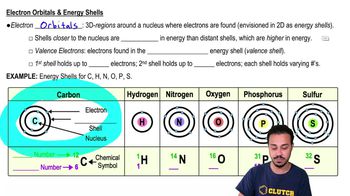
Electron Orbitals & Energy Shells
27260
views
581
rank
Termini in questo insieme (33)
Nascondere definizioni
What is an atom?
An atom is the smallest unit of an element, consisting of a nucleus with protons and neutrons, surrounded by electrons.
What are the charges of subatomic particles?
Protons are positively charged, neutrons are neutral, and electrons are negatively charged.
What defines an element's atomic number?
The atomic number equals the number of protons in an atom and uniquely identifies the element.
What is an ion?
An ion is a charged atom with an unequal number of protons and electrons.
Difference between cation and anion?
Cations are positively charged ions (lost electrons), anions are negatively charged ions (gained electrons).
What are isotopes?
Isotopes are atoms of the same element with the same number of protons but different numbers of neutrons.
Define molecule and compound.
A molecule is two or more atoms bonded together; a compound is a molecule made of different elements.
What is a molecular formula?
A molecular formula shows the types and numbers of atoms in a molecule.
Difference between organic and inorganic molecules?
Organic molecules contain carbon and hydrogen; inorganic molecules may lack hydrogen.
What are functional groups?
Functional groups are specific groups of atoms within molecules that determine chemical properties and reactions.
Name key biologically important functional groups.
Alcohol (R-OH), Amine (R-NH2), Carboxyl (R-COOH), Ester (R-COO-R'), Methyl (R-CH3), Phosphate (R-PO4^2-), Sulfhydryl (R-SH).
What is an acid and a base in aqueous solutions?
Acids add hydrogen ions (H+) to solution; bases add hydroxide ions (OH-).
What is a salt in chemistry?
Salts form when acids and bases react, combining anions from acids and cations from bases.
What does the pH scale measure?
The pH scale measures the acidity or basicity of a solution based on hydrogen ion concentration.
What is a buffer?
A buffer stabilizes pH by absorbing or releasing hydrogen ions to maintain a constant pH.
What are valence electrons?
Valence electrons are electrons in the outermost shell that participate in chemical bonding.
Difference between ionic and covalent bonds?
Ionic bonds form by transfer of electrons creating charged ions; covalent bonds form by sharing electron pairs.
What is a polar covalent bond?
A polar covalent bond involves unequal sharing of electrons, creating partial positive and negative charges.
What are hydrogen bonds?
Hydrogen bonds are weak electrostatic attractions between polar molecules or within large molecules.
Define hydrophilic, hydrophobic, and amphipathic molecules.
Hydrophilic molecules dissolve in water; hydrophobic molecules repel water; amphipathic molecules have both properties.
What is a synthesis reaction?
A synthesis reaction builds larger molecules from smaller reactants, often releasing water (dehydration synthesis).
What is a decomposition reaction?
A decomposition reaction breaks down molecules into smaller components, often adding water (hydrolysis).
What is activation energy?
Activation energy is the minimum energy required to start a chemical reaction.
Difference between endergonic and exergonic reactions?
Endergonic reactions require more energy than they release; exergonic reactions release more energy than they require.
What are the four main classes of biomolecules?
Carbohydrates, lipids, nucleic acids, and proteins.
What are the building blocks of carbohydrates?
Simple sugars called monosaccharides.
What type of bond links monosaccharides?
Glycosidic bonds formed by dehydration synthesis.
Difference between saturated and unsaturated fats?
Saturated fats have no double bonds and are solid at room temperature; unsaturated fats have double bonds and are liquid.
What are nucleotides composed of?
A five-carbon sugar, one or more phosphate groups, and a nitrogenous base.
What is the difference between DNA and RNA nucleotides?
DNA contains deoxyribose sugar and thymine; RNA contains ribose sugar and uracil.
What are proteins made of?
Proteins are polymers of amino acids linked by peptide bonds.
Name the four levels of protein structure.
Primary (amino acid sequence), secondary (alpha-helices and beta-sheets), tertiary (3D folding), quaternary (multiple polypeptide chains).
What role do chaperone proteins play?
Chaperones assist in proper protein folding to achieve functional structure.
 IndietroIndietro
 02:13
02:13