Skip to main content
Microbiology
Il mio corso
Impara
Preparazione agli esami
AI Tutor
Guide di studio
Soluzioni per libri di testo
Flashcard
Esplora
Prova l'app
Il mio corso
Impara
Preparazione agli esami
AI Tutor
Guide di studio
Soluzioni per libri di testo
Flashcard
Esplora
Prova l'app
Indietro
Microbiology: Cell Transport and Bacterial Structures
Puoi toccare per girare la carta.
Why do cells transport materials?
Puoi toccare per girare la carta.
👆
Why do cells transport materials?
To get
nutrients
and remove
waste
.
Avanzamenti del tracciato
I pulsanti di controllo sono stati cambiati in modalità "navigazione".
1/20
Video consigliati
02:26
Map of the Lesson on Membrane Transport
19753
views
244
rank
03:00
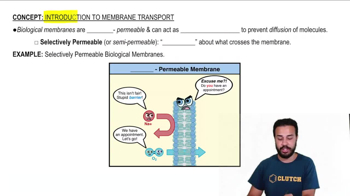
Introduction to Membrane Transport
24730
views
405
rank
05:31
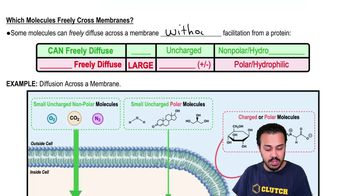
Which Molecules Freely Cross Membranes?
22167
views
323
rank
Termini in questo insieme (20)
Nascondere definizioni
Why do cells transport materials?
To get
nutrients
and remove
waste
.
Does passive transport require energy?
No, passive transport does
not
require energy.
Does active transport require energy?
Yes, active transport
requires energy
.
What is diffusion?
Movement of molecules from
high to low concentration
.
Is diffusion passive or active?
Diffusion is a
passive
process.
Does diffusion require ATP?
No, diffusion does
not
require ATP.
What is osmosis?
Movement of
water
across a membrane.
Is osmosis passive or active?
Osmosis is a
passive
process.
Does osmosis require ATP?
No, osmosis does
not
require ATP.
Is primary active transport active?
Yes, primary active transport is an
active
process.
Does primary active transport directly use energy?
Yes, it directly uses
energy
(usually ATP).
Is secondary active transport active?
Yes, secondary active transport is an
active
process.
Does secondary active transport use an ion gradient?
Yes, it uses an
ion gradient
to drive transport.
What is the bacterial plasma membrane made mainly of?
Mainly
phospholipids
and
proteins
.
Which part of a phospholipid is hydrophilic?
The
head
is hydrophilic (likes water).
Which part of a phospholipid is hydrophobic?
The
tails
are hydrophobic (avoid water).
What do membrane proteins help do?
They help
transport materials
across the membrane.
What is an endospore?
A
dormant survival structure
formed by some bacteria.
Why do bacteria make endospores?
To
survive harsh conditions
like heat or desiccation.
Are endospores used for reproduction?
No, endospores are for survival,
not reproduction
.
 IndietroIndietro
 02:26
02:26