 Indietro
Microbiology Chapter 1: The Microbial World
 03:36
03:36

Termini in questo insieme (30)
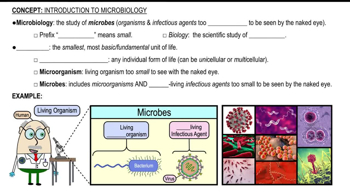
Microorganisms are living things too small to be seen with the unaided eye and are found everywhere, including on and in the human body.
They decompose dead plants and animals, recycle chemical elements, and help maintain human health as normal microbiota.
A system of naming organisms using two names: the genus (capitalized) and the specific epithet (lowercase), both italicized or underlined.
Bacteria are unicellular, prokaryotic, usually have peptidoglycan cell walls, reproduce by binary fission, and may have flagella.
Archaea are prokaryotic but lack peptidoglycan in their cell walls and often live in extreme environments.
Fungi are eukaryotic, mostly multicellular, have a true nucleus, and obtain nutrients by absorbing organic material.
Unicellular eukaryotes that obtain nutrients by absorption or ingestion through specialized structures.
Algae are eukaryotic and obtain nourishment through photosynthesis, producing oxygen and carbohydrates.
Viruses are noncellular entities with a nucleic acid core (DNA or RNA), a protein coat called a capsid, and sometimes an outer envelope.
Multicellular parasitic worms including flatworms and roundworms.
Bacteria (prokaryotic), Archaea (prokaryotic without peptidoglycan), and Eukarya (eukaryotic with nucleus).
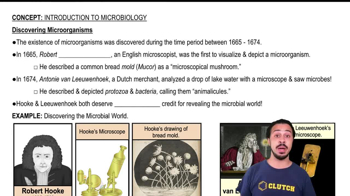
Robert Hooke observed cork cells and helped establish the foundation for cell theory.
Antonie van Leeuwenhoek, using a simple microscope around 1673.
The disproven belief that living organisms can arise from nonliving matter.
Maggots on decaying meat come from flies laying eggs, not spontaneous generation.
He heated nutrient broth and observed microbial growth, interpreting it as support for spontaneous generation.
He heated broth more thoroughly and sealed containers, preventing microbial growth and suggesting contamination caused Needham's results.
The concept that living cells arise only from preexisting cells, introduced by Rudolf Virchow in 1858.
Microorganisms come from existing microorganisms, disproving spontaneous generation.
A heating process to kill or reduce harmful microorganisms in products like milk, without sterilizing them.
Four steps to prove a specific microorganism causes a specific disease: presence, isolation, causation, and re-isolation.
Edward Jenner used cowpox material to provide immunity against smallpox in 1798.
An organism with little or no ability to cause disease, used in some vaccines.
Synthetic drugs are chemically made in labs; antibiotics are naturally produced by bacteria or fungi to inhibit bacterial growth.
Penicillin, an antibiotic produced by the Penicillium fungus that inhibits bacterial growth.
The use of microorganisms to produce foods, chemicals, proteins, enzymes, and vaccines.
Viruses can be used to deliver genes into human cells to replace or compensate for defective genes.
A community of microorganisms forming a slimy layer on surfaces, protecting microbes from antimicrobials and host defenses.
A disease caused when pathogens invade a susceptible host.
Changes in microorganisms, genetics, human behavior, environment, travel, and drug resistance.