What is the composition of the cell wall in plants, fungi, and yeasts?
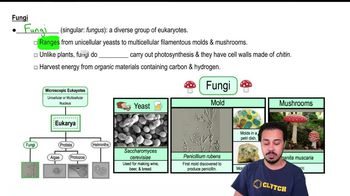
The cell wall is made of carbohydrates: cellulose in plants, chitin in fungi, and glucan and mannan in yeasts.
What is the glycocalyx and its functions?
The glycocalyx consists of carbohydrates bonded to proteins and lipids in the plasma membrane; it strengthens the cell surface, helps attach cells to each other, and is involved in cell–cell recognition.
What is the basic structure of the plasma (cytoplasmic) membrane in eukaryotes?
It is a phospholipid bilayer with integral and peripheral proteins, similar to prokaryotic membranes but also contains sterols and carbohydrates.
What are the three types of endocytosis in eukaryotic cells?
Phagocytosis (engulfing particles with pseudopods), pinocytosis (membrane folds inward to bring in fluid), and receptor-mediated endocytosis.
Define cytoplasm, cytosol, and cytoskeleton.
Cytoplasm is the substance inside the plasma membrane excluding the nucleus; cytosol is the fluid portion of cytoplasm; cytoskeleton is made of microfilaments, intermediate filaments, and microtubules providing shape and support.
What are the differences between 80S and 70S ribosomes in eukaryotic cells?
80S ribosomes (60S + 40S subunits) are found in the cytoplasm and on rough ER; 70S ribosomes are found in chloroplasts and mitochondria.
What is the structure and function of the nucleus?
The nucleus is a double membrane structure enclosing DNA complexed with histones as chromatin; chromatin condenses into chromosomes during mitosis and meiosis.
What are the roles of rough and smooth endoplasmic reticulum?
Rough ER has ribosomes and synthesizes proteins; smooth ER lacks ribosomes and synthesizes cell membranes, fats, and hormones.
What is the function of the Golgi complex?
The Golgi complex modifies proteins from the ER and transports them via secretory vesicles to the plasma membrane.
What are lysosomes and their function?
Lysosomes are vesicles formed in the Golgi complex containing digestive enzymes for breaking down cellular waste.
What are vacuoles and their roles in eukaryotic cells?
Vacuoles are cavities formed from the Golgi complex or endocytosis; they bring food into cells, provide shape, and store substances.
Describe the structure and function of mitochondria.
Mitochondria have a double membrane with inner folds called cristae and a matrix; they produce ATP via cellular respiration and contain 70S ribosomes and circular DNA.
What are chloroplasts and their key features?
Chloroplasts contain thylakoids with chlorophyll for photosynthesis and have 70S ribosomes and circular DNA.
What is the function of peroxisomes?
Peroxisomes oxidize fatty acids and destroy hydrogen peroxide (H2O2).
What are centrosomes and their components?
Centrosomes consist of the pericentriolar matrix (protein fibers) and centrioles (microtubule cylinders); they organize the mitotic spindle and play a critical role in cell division.
 Indietro
 01:27
01:27