 Indietro
Microbiology: Genetics and Molecular Biology
 05:45
05:45
Termini in questo insieme (35)
A genome is the complete set of genetic material (DNA) in an organism, including all of its genes and non-coding sequences.
A gene is a segment of DNA that codes for a functional product, usually a protein or RNA molecule.
An organism's genotype is the complete set of genes it carries, representing its genetic makeup.
An organism's phenotype is the observable physical or biochemical characteristics resulting from gene expression and environmental influences.
A plasmid is a small, circular, double-stranded DNA molecule separate from chromosomal DNA, often carrying genes that confer advantages like antibiotic resistance.
Prokaryotic genomes are simpler, usually a single circular chromosome located in the cytoplasm; eukaryotic genomes are complex, with multiple linear chromosomes inside a nucleus and include non-coding DNA.
A nucleotide consists of a phosphate group, a five-carbon sugar (deoxyribose or ribose), and a nitrogenous base.
DNA nucleotides: adenine (A), thymine (T), cytosine (C), guanine (G). RNA nucleotides: adenine (A), uracil (U), cytosine (C), guanine (G).
Thymine (T) in DNA is replaced by uracil (U) in RNA.
The three main types are mRNA (messenger RNA), tRNA (transfer RNA), and rRNA (ribosomal RNA).
Only mRNA is translated into proteins; tRNA and rRNA function directly as RNA molecules and are not translated.
RNA is usually single-stranded, contains ribose sugar, and uracil; DNA is double-stranded, contains deoxyribose, and thymine. RNA functions in protein synthesis; DNA stores genetic information.
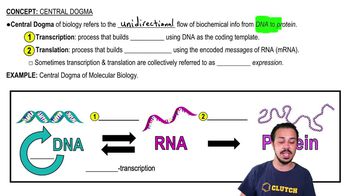
The central dogma describes the flow of genetic information: DNA → RNA → Protein.
DNA replication is the process of copying the DNA molecule to produce two identical DNA strands before cell division.
An enzyme is a protein that catalyzes biochemical reactions, often ending with '-ase' (e.g., DNA ligase).
Helicase unwinds and separates the two DNA strands to allow replication.
Primase synthesizes short RNA primers to provide starting points for DNA polymerase.
DNA polymerase III adds nucleotides to the growing DNA strand during replication.
DNA polymerase I removes RNA primers and replaces them with DNA nucleotides.
Ligase joins Okazaki fragments on the lagging strand by forming phosphodiester bonds.
The leading strand is synthesized continuously; the lagging strand is synthesized discontinuously in Okazaki fragments.
Okazaki fragments are short DNA segments synthesized on the lagging strand during replication.
Gene expression is the process by which information from a gene is used to produce a functional product, usually a protein.
Transcription is the synthesis of RNA from a DNA template.
RNA polymerase synthesizes RNA during transcription.
In prokaryotes, transcription occurs in the cytoplasm; in eukaryotes, it occurs in the nucleus.
Reverse transcription is the synthesis of DNA from an RNA template, catalyzed by reverse transcriptase.
mRNA carries the genetic code for proteins; tRNA delivers amino acids; rRNA forms the core of ribosomes.
Translation is the process of synthesizing proteins from mRNA at the ribosome.
The genetic code encodes 20 standard amino acids.
Redundancy means multiple codons can code for the same amino acid.
Translation occurs in the cytoplasm in both prokaryotes and eukaryotes, but in eukaryotes it happens on ribosomes outside the nucleus.
The start codon signals translation initiation; its typical RNA sequence is AUG.
In both prokaryotes and eukaryotes, the start codon AUG codes for methionine.
Translation terminates and the newly made protein is released when the ribosome encounters a stop codon.