 Indietro
Microbiology: Genetics, Protein Synthesis, Mutation, and Staining
 05:45
05:45
Termini in questo insieme (35)
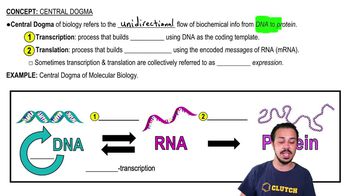
The flow of genetic material from DNA to RNA to protein.
RNA has a ribose sugar (with 2' OH), uses uracil instead of thymine, and is usually single-stranded, unlike DNA.
Both have a sugar, phosphate group, and nitrogenous base; DNA has deoxyribose, RNA has ribose.
Gyrase relieves supercoiling ahead of the replication fork by cutting and rejoining DNA strands.
Helicase unwinds and separates the double-stranded DNA at the replication fork.
DNA polymerase III synthesizes new DNA strands by adding nucleotides to the 3' end of the primer.
DNA polymerase I removes RNA primers and replaces them with DNA nucleotides.
Primase synthesizes short RNA primers to provide a starting point for DNA polymerase.
Ligase joins Okazaki fragments on the lagging strand by forming phosphodiester bonds.
DNA strands are antiparallel; leading strand is synthesized continuously 5' to 3', lagging strand discontinuously as Okazaki fragments.
Each new DNA molecule contains one original strand and one newly synthesized strand.
The specific DNA sequence where replication begins and the replication fork forms.
RNA polymerase synthesizes mRNA from DNA template; no introns; occurs in cytoplasm.
mRNA carries the code, rRNA forms ribosomes, tRNA brings amino acids matching codons.
Codons are 3-base sequences on mRNA; anticodons are complementary 3-base sequences on tRNA.
Introns are non-coding sequences removed during RNA processing; exons are coding sequences expressed in proteins.
A cluster of genes under control of a single promoter and operator, allowing coordinated gene expression.
Inducible operons are off until activated by an inducer; repressible operons are on until turned off by a corepressor.
Operons provide efficient, coordinated regulation of genes for metabolic advantage.
Conversion of RNA back to DNA; used by retroviruses like HIV.
Mutations create genetic variation, which natural selection can act upon.
Base analogs mimic bases causing mispairing; UV light causes thymine dimers disrupting DNA replication.
Deletion/insertion add/remove bases; frameshift alters reading frame; silent no amino acid change; nonsense creates stop codon; missense changes amino acid.
By additional insertions or deletions restoring the reading frame downstream.
To detect mutagenic potential of chemicals using bacteria.
A DNA repair process that removes damaged bases and replaces them to prevent mutations.
The exchange of genetic material between DNA molecules, increasing genetic diversity.
Through conjugation, transformation, and transduction.
Transfer of plasmids via pili between bacteria, spreading genes and increasing diversity.
Non-virulent bacteria acquired virulence by uptake of DNA from dead virulent bacteria.
Transfer of bacterial DNA by bacteriophages, leading to genetic variation.
Small circular DNA molecules that carry genes, important for antibiotic resistance and genetic engineering.
Use of a single stain to color cells, revealing shape and arrangement.
Positive stains color the cells; negative stains color the background.
To kill bacteria and fix them to the slide for staining.