Indietro

Microbiology Key Concepts and Scientists

I pulsanti di controllo sono stati cambiati in modalità "navigazione".
1/42
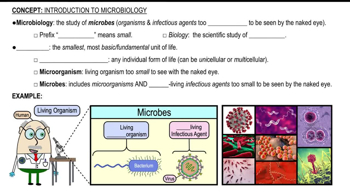
  • Five groups of living microorganisms and two nonliving/noncellular entities

    • Bacteria
    • Archaea
    • Fungi
    • Protozoa
    • Algae
    • Viruses (nonliving)
    • Prions (nonliving)
  • Endosymbiotic theory

    Theory that some organelles in eukaryotic cells originated from free-living prokaryotes engulfed by ancestral cells.
  • Pathogen vs Opportunistic pathogen

    Pathogen: Microorganism that causes disease.
    Opportunistic pathogen: Causes disease only in weakened hosts or when normal barriers are breached.
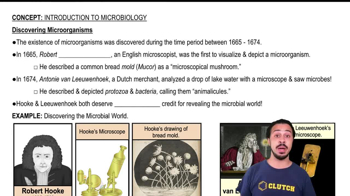
  • Robert Hooke's contribution to microbiology

    First to describe cells using a microscope, coining the term 'cell' after observing cork.
  • Antonie van Leeuwenhoek's contribution

    Observed and described live microorganisms, called 'animalcules', using improved microscopes.
  • Carolus Linnaeus' contribution

    Developed binomial nomenclature, the system of naming organisms with genus and species.
  • Edward Jenner's contribution

    Developed the first vaccine using cowpox to protect against smallpox.
  • Ignaz Semmelweis' contribution

    Introduced handwashing to reduce puerperal fever in hospitals.
  • Florence Nightingale's contribution

    Pioneered modern nursing and emphasized sanitation to reduce infections.
  • Louis Pasteur's contributions

    Disproved spontaneous generation; developed pasteurization and vaccines; supported germ theory.
  • Joseph Lister's contribution

    Introduced antiseptic surgical techniques to reduce infections.
  • Alexander Fleming's contribution

    Discovered penicillin, the first antibiotic.
  • Rosalind Franklin's contribution

    Produced X-ray diffraction images critical to discovering DNA's double helix structure.
  • Emmanuelle Charpentier & Jennifer Doudna's contribution

    Developed CRISPR-Cas9 gene-editing technology.
  • Hypothesis of spontaneous generation vs biogenesis

    Spontaneous generation: Life arises from nonliving matter.
    Biogenesis: Life arises from existing life.
    Biogenesis was proven correct by Redi and Pasteur.
  • Germ theory of disease

    Theory that microorganisms are the cause of many diseases.
  • Etiological agent

    The specific microorganism that causes a particular disease.
  • Scientist who established criteria for etiological agents

    Robert Koch established criteria known as Koch's postulates.
  • Aseptic technique and its importance

    Procedures to prevent contamination by pathogens; central to healthcare to reduce infections.
  • Nosocomial infection

    An infection acquired in a hospital or healthcare setting.
  • Scientific method steps

    1. Ask a question
    2. Form a hypothesis
    3. Conduct experiments
    4. Analyze data
    5. Draw conclusions
  • Microbe morphology

    The shape, size, and arrangement of microbial cells.
  • The three domains of life

    • Bacteria
    • Archaea
    • Eukarya
  • Definition of a strain

    A genetic variant or subtype of a microorganism species.
  • Binomial nomenclature and its developer

    System of naming species with genus and species names; developed by Carolus Linnaeus.
  • Symbiotic relationships: parasitism, mutualism, commensalism

    • Parasitism: one benefits, other harmed
    • Mutualism: both benefit
    • Commensalism: one benefits, other unaffected
  • Normal microbiota and its symbiotic relation

    Microbes normally living on/in the body; usually mutualistic or commensal.
  • Common cause of disruption in normal microbiota

    Antibiotic use or illness can disrupt normal microbiota.
  • Biofilm and example

    Community of microbes attached to a surface; example: dental plaque.
  • Bioremediation

    Use of microbes to clean up environmental pollutants.
  • Culture media (growth media)

    Nutrient solutions used to grow microorganisms in the lab.
  • Goal of aseptic culturing techniques

    Prevent contamination of cultures and environment.
  • Streak plate technique and bacterial colony

    Method to isolate bacteria by spreading cells; a colony is a visible cluster from one cell.
  • Simple staining reveals what bacterial properties?

    Cell shape, size, and arrangement.
  • Three structural staining methods and definitions of endospores and capsules

    • Endospore stain: detects resistant spores
    • Capsule stain: detects protective outer layer
    • Flagella stain: visualizes motility structures
  • Gram stain differentiates based on what cell wall characteristic?

    Thickness of peptidoglycan layer.
  • Gram-positive and Gram-negative cell colors

    Gram-positive: purple; Gram-negative: pink/red.
  • Acid-fast stain differentiates based on what cell wall characteristic?

    Presence of mycolic acid (waxy substance).
  • Waxy substance tested in acid-fast stain

    Mycolic acid.
  • Colors of acid-fast positive and negative organisms

    Acid-fast positive: red; Acid-fast negative: blue.
  • How to determine total magnification on a compound microscope

    Multiply the eyepiece magnification by the objective lens magnification.
  • Why is immersion oil used with 100x objective lens?

    To reduce light refraction and increase resolution.