 Indietro
Microbiology: Pathology, Infection, and Disease
 03:25
03:25
Termini in questo insieme (35)
Pathology is the study of disease.
Etiology refers to the cause of a disease.
Pathogenesis describes how a disease develops.
Infection is the invasion or colonization of the body by pathogens.
An infectious disease occurs when an infection changes the state of health.
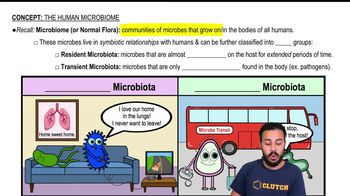
The human microbiome begins developing at birth and consists of normal and transient microbiota.
Normal microbiota permanently colonize the body; transient microbiota remain for days, weeks, or months.
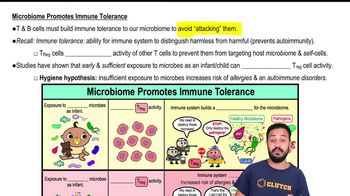
Microbial antagonism, or competitive exclusion, is when normal microbiota compete with pathogens for nutrients and space.
Normal microbiota may produce substances harmful to invading microorganisms.
Fecal microbial transfer may help restore normal microbiota, especially after Clostridium difficile infections.
Commensalism benefits one organism while the other is unaffected.
Mutualism benefits both organisms involved.
Parasitism benefits one organism at the expense of the host.
Symptoms are subjective changes felt by the patient; signs are objective changes observed or measured.
A syndrome is a group of signs and symptoms occurring together.
Communicable diseases spread from one person to another.
Tetanus is an example of a non-communicable disease.
Incidence is the number of new cases during a specific time period.
Prevalence includes both old and new cases of a disease in a population.
An endemic disease is constantly present in a population.
A pandemic is a worldwide epidemic.
Acute diseases develop rapidly and last a short time; chronic diseases develop slowly and last longer.
A latent disease becomes inactive and later reactivates.
Herd immunity occurs when most of a population is immune to a disease.
A local infection is limited to a small area; a systemic infection spreads through blood and lymph.
Septicemia involves bacterial growth in the blood.
A primary infection causes the initial disease.
A secondary infection follows a primary infection.
Predisposing factors increase susceptibility to disease, such as age, nutrition, vaccination status, and stress.
Stages include incubation period, prodromal period, period of illness, and convalescence.
Reservoirs are continual sources of infections, including asymptomatic carriers, animals (zoonoses), soil, and water.
Direct contact transmission requires close physical contact between hosts.
A fomite is a nonliving object that can transmit pathogens indirectly.
Mechanical transmission carries pathogens on the vector's body surface; biological transmission involves pathogen reproduction inside the vector.
HAIs are infections acquired while receiving treatment in a healthcare facility.