The two prokaryotic domains are Bacteria and Archaea.
Do prokaryotic organisms contain membrane-bound organelles? Are prokaryotes multicellular or unicellular?
Prokaryotes do not contain membrane-bound organelles and are typically unicellular.
What does it mean if a bacterium is pleomorphic? What advantage does it give the microbe?
A pleomorphic bacterium can vary in shape and size, allowing it to adapt to different environments.
How do most prokaryotes obtain nutrients?
Most prokaryotes obtain nutrients through absorption from their environment.
Describe common prokaryote shapes and arrangements.
Common shapes include cocci (spherical), bacilli (rod-shaped), and spirilla (spiral). Arrangements vary like chains, clusters, or pairs.
What reproduction process is used by most prokaryotes? Is it sexual or asexual?
Most prokaryotes reproduce by binary fission, an asexual process.
Describe the basic structure and main function of a prokaryotic plasma membrane.
The plasma membrane is a phospholipid bilayer that controls selective transport of substances in and out of the cell.
Where is the cell wall located relative to the plasma membrane in prokaryotes?
The cell wall is located outside the plasma membrane, providing structural support and protection.
What is the core component of bacterial cell walls?
The core component of bacterial cell walls is peptidoglycan.
What is the core component of archaea cell walls?
Archaea cell walls lack peptidoglycan and often contain pseudopeptidoglycan or other unique polymers.
What glycolipid enriches the outer membrane of Gram-negative bacteria?
The outer membrane contains lipopolysaccharide (LPS), a glycolipid.
Which part of lipopolysaccharide acts as an endotoxin?
The lipid A portion of LPS acts as an endotoxin.
Where in the body are enteric bacteria commonly found?
Enteric bacteria are commonly found in the intestinal tract.
Why are Gram-negative bacteria less susceptible to penicillin than Gram-positive bacteria?
Gram-negative bacteria have an outer membrane that blocks penicillin from reaching the peptidoglycan layer.
Name two genera of acid-fast bacteria.
Two well-known acid-fast genera are Mycobacterium and Nocardia.
Are acid-fast organisms considered Gram-positive or Gram-negative?
Acid-fast organisms are considered Gram-positive despite a weak Gram stain reaction.
Which bacterial genus lacks cell walls?
The genus Mycoplasma lacks cell walls.
What is the difference between L-forms and Mycoplasma?
L-forms are bacteria that lose their cell walls temporarily, while Mycoplasma naturally lack cell walls.
What is the difference between active and passive transport?
Active transport requires energy to move substances against a gradient; passive transport does not require energy and moves substances down a gradient.
What is diffusion? Is it active or passive?
Diffusion is the passive movement of molecules from high to low concentration.
What is the difference between simple diffusion and facilitated diffusion?
Simple diffusion moves molecules directly through the membrane; facilitated diffusion uses protein channels or carriers.
What is osmosis? Is it active or passive?
Osmosis is the passive diffusion of water across a selectively permeable membrane.
What is the function of flagella in prokaryotes?
Flagella provide motility, allowing bacteria to move.
Define chemotaxis and phototaxis.
Chemotaxis is movement toward or away from chemicals; phototaxis is movement in response to light.
What is the function of fimbriae and pili?
Fimbriae help with attachment to surfaces; pili assist in DNA transfer between cells.
How do bacterial capsules increase pathogenicity?
Capsules protect bacteria from phagocytosis and help adhere to host tissues.
What is the main molecule contained in the nucleoid region of bacteria?
The nucleoid contains the bacterial chromosomal DNA.
What is the function of ribosomes in prokaryotes?
Ribosomes synthesize proteins by translating mRNA.
How do prokaryotic ribosomes differ from eukaryotic ribosomes?
Prokaryotic ribosomes are 70S (50S + 30S), while eukaryotic ribosomes are 80S (60S + 40S).
What supports the endosymbiotic theory regarding chloroplasts and mitochondria?
Chloroplasts and mitochondria have 70S ribosomes similar to prokaryotes, supporting their bacterial origin.
What is the function of the prokaryotic cytoskeleton?
The cytoskeleton helps maintain cell shape and assists in cell division.
What are inclusion bodies and their function?
Inclusion bodies store nutrients or energy reserves inside the cell.
How do endospores differ from vegetative cells?
Endospores are dormant, resistant forms that survive harsh conditions; vegetative cells are metabolically active.
Name three genera that produce medically relevant endospores.
The genera Bacillus, Clostridium, and Clostridioides produce medically important endospores.
 Indietro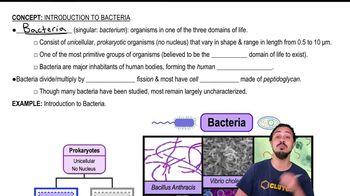
 06:18
06:18