Indietro

Microbiology: Science Basics and Matter Properties
I pulsanti di controllo sono stati cambiati in modalità "navigazione".
1/30
  • What is science?

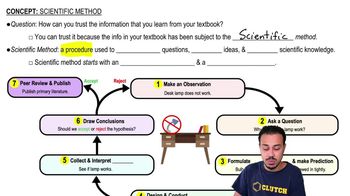
    Science is the study of the natural world using observations, experiments, and evidence.

  • What are the main steps of the scientific method?

    Observation → Question → Hypothesis → Experiment → Analyze results → Conclusion.

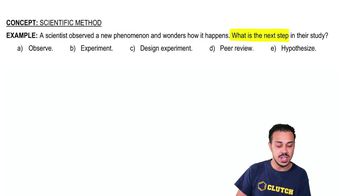
  • What usually comes after a hypothesis in the scientific method?

    An experiment is conducted to test the hypothesis.

  • What happens after an experiment?

    Analyze the results and make a conclusion.

  • What is a hypothesis?

    A testable explanation or prediction.

  • What makes a hypothesis scientific?

    It must be testable.

  • What does a scientific law describe?

    A scientific law describes WHAT happens.

  • What does a scientific theory explain?

    A scientific theory explains WHY or HOW something happens.

  • Does a scientific theory become a law?

    No, they have different purposes: Law = WHAT, Theory = WHY/HOW.

  • What is a physical property?

    A property observed without changing the substance into something new.

  • What is a chemical property?

    A property describing how a substance can change into a new substance.

  • Is color a physical or chemical property?

    Physical property.

  • Is flammability a physical or chemical property?

    Chemical property.

  • What is an element?

    A pure substance made of only one type of atom.

  • What is a compound?

    Two or more different elements chemically bonded together.

  • Is O₂ an element or compound? Why?

    O₂ is an element because it contains only oxygen atoms.

  • Is H₂O an element or compound?

    Compound.

  • What is a homogeneous mixture?

    A mixture that is uniform throughout.

  • What is a heterogeneous mixture?

    A mixture that is not uniform throughout.

  • Is salt water homogeneous or heterogeneous?

    Homogeneous.

  • Is oil and water homogeneous or heterogeneous?

    Heterogeneous.

  • What are the three main states of matter?

    Solid, liquid, and gas.

  • What shape and volume does a solid have?

    Fixed shape and fixed volume.

  • How are particles arranged in a solid?

    Tightly packed.

  • What shape and volume does a liquid have?

    No fixed shape but fixed volume.

  • How are particles arranged in a liquid?

    Close together but able to move past each other.

  • What shape and volume does a gas have?

    No fixed shape and no fixed volume.

  • How are particles arranged in a gas?

    Far apart and moving freely.

  • What is the phase change from solid to liquid?

    Melting.

  • What is the phase change from liquid to gas?

    Vaporization.