 Indietro
Microbiology Study Guide Flashcards
 03:36
03:36

Termini in questo insieme (29)
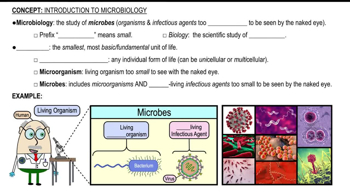
Living groups: bacteria, archaea, fungi, protozoa, algae. Nonliving/noncellular entities: viruses, prions.
The theory that certain organelles like mitochondria and chloroplasts originated as free-living bacteria engulfed by ancestral eukaryotic cells.
A pathogen causes disease in healthy hosts; an opportunistic pathogen causes disease only when the host's defenses are compromised.
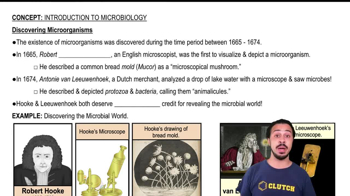
First to describe cells using a microscope, coining the term 'cell'.
Observed and described live microorganisms, called 'animalcules', using improved microscopes.
Developed binomial nomenclature, the system of naming organisms with genus and species.
Developed the first vaccine using cowpox to protect against smallpox.
Introduced handwashing to reduce puerperal fever in hospitals.
Disproved spontaneous generation; developed pasteurization and germ theory of disease.
Introduced aseptic surgical techniques using antiseptics to reduce infections.
Discovered penicillin, the first antibiotic.
Spontaneous generation: life arises from nonliving matter. Biogenesis: life arises from existing life. Biogenesis was proven correct by Redi and Pasteur.
The theory that microorganisms are the cause of many diseases.
The specific microorganism or pathogen that causes a particular disease.
Robert Koch established criteria (Koch's postulates) to link specific microbes to diseases.
Procedures to prevent contamination by pathogens; central to healthcare to reduce infections.
An infection acquired in a hospital or healthcare setting.
Bacteria, Archaea, and Eukarya.
A two-part naming system for organisms using genus and species, developed by Linnaeus.
Parasitism: one benefits, other harmed.
Mutualism: both benefit.
Commensalism: one benefits, other unaffected.
Microorganisms normally living on or in the body, usually in a mutualistic or commensal relationship.
A community of microorganisms attached to a surface, embedded in a protective matrix. Example: dental plaque.
Substances used to grow microorganisms in the lab, providing nutrients and environment for growth.
The thickness of the peptidoglycan layer in bacterial cell walls.
Gram-positive: purple.
Gram-negative: pink/red.
The presence of mycolic acid, a waxy substance in the cell walls of acid-fast bacteria.
Objective lens magnification multiplied by ocular lens magnification.
Provide motility to bacterial cells.
Active transport requires energy to move substances against a gradient; passive transport does not require energy and moves substances down a gradient.