Skip to main content
Microbiology
Il mio corso
Impara
Preparazione agli esami
AI Tutor
Guide di studio
Soluzioni per libri di testo
Flashcard
Esplora
Prova l'app
Il mio corso
Impara
Preparazione agli esami
AI Tutor
Guide di studio
Soluzioni per libri di testo
Flashcard
Esplora
Prova l'app
Indietro
Microbiology: Viruses and Prions
Puoi toccare per girare la carta.
What are viruses?
Puoi toccare per girare la carta.
👆
What are viruses?
Obligate intracellular parasites
that require a host cell to reproduce; they infect bacteria, protozoa, fungi, algae, plants, and animals.
Avanzamenti del tracciato
I pulsanti di controllo sono stati cambiati in modalità "navigazione".
1/20
Video consigliati
04:47
General Structure of Viruses
5820
views
165
rank
2
comments
03:19
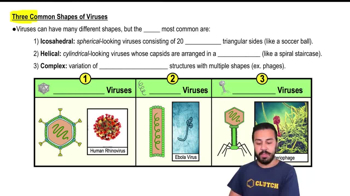
Three Common Shapes of Viruses
4197
views
71
rank
05:09
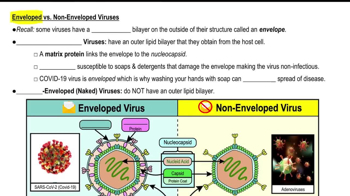
Enveloped vs. Non-Enveloped Viruses
5032
views
96
rank
Termini in questo insieme (20)
Nascondere definizioni
What are viruses?
Obligate intracellular parasites
that require a host cell to reproduce; they infect bacteria, protozoa, fungi, algae, plants, and animals.
Do viruses fulfill the characteristics of life independently?
No, viruses
do not independently fulfill the characteristics of life
and are not cells.
What is the basic structure of a virus?
A
protein shell (capsid)
surrounding a nucleic acid core, which can be either DNA or RNA, but not both.
What is a nucleocapsid?
The
capsid together with the nucleic acid
inside the virus.
What is the difference between naked and enveloped viruses?
Naked viruses consist only of a nucleocapsid; enveloped viruses have an
external membrane derived from the host cell membrane
.
What are viral spikes and their function?
Protein projections on the virus surface that
allow viruses to dock with host cells
.
What are the two basic viral capsid shapes?
Icosahedral
(20 triangular faces, very stable) and
helical
(rod-shaped, all animal helical viruses are enveloped).
What types of nucleic acids can viruses have?
Viruses can have
single-stranded or double-stranded DNA or RNA
, but never both DNA and RNA simultaneously.
What is a retrovirus?
An RNA virus that carries enzymes to
create DNA from its RNA
for integration into the host genome.
What is the genome size of viruses compared to cells?
Viral genomes are
much smaller
; for example, hepatitis B virus has only four genes.
What is a persistent viral infection?
A state where the virus remains in the host cell without immediate lysis, potentially lasting for the host's life.
What is a chronic latent viral infection?
A viral infection that
periodically reactivates
under stimuli, such as herpes simplex and herpes zoster viruses.
How do viruses contribute to cancer?
Some viruses carry oncogenes or produce proteins that
disrupt growth regulation
, leading to cancer.
Name some oncoviruses and the cancers they cause.
Papillomaviruses (cervical cancer), herpesviruses, hepatitis B virus (liver cancer), and human T-lymphotropic virus (leukemia, lymphoma).
What is a bacteriophage?
A virus that infects bacteria, often making the bacteria more pathogenic to humans.
How are animal viruses cultivated for study?
Using
in vivo
methods (lab animals, embryonic tissues) or
in vitro
cell or tissue cultures.
What are plaques in viral culture?
Clear areas on a cell sheet where virus-infected cells have been destroyed, indicating viral growth.
What are prions?
Infectious proteins with an unclear mode of infection, causing diseases like Creutzfeldt-Jakob and mad cow disease.
Why are antibiotics ineffective against viral infections?
Because antibiotics target bacterial processes, and viruses lack the metabolic machinery targeted by antibiotics.
What is the size range of viruses?
Viruses range from about
20 nm (parvoviruses)
to
150 nm (herpes simplex virus)
and require electron microscopy to be seen.
 IndietroIndietro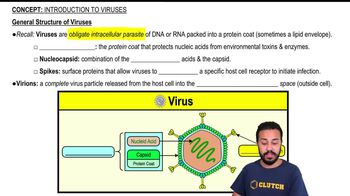
 04:47
04:47