 Indietro
Viruses and Prions - Microbiology Chapter 6
 04:47
04:47
Termini in questo insieme (21)
Virology is the study of viruses and viral diseases.
Viruses lack cellular structure and cannot reproduce or carry out metabolism independently, so they are classified as nonliving microbes.
Viruses are acellular, lack organelles, and depend on host cells for replication, unlike prokaryotic and eukaryotic cells which are cellular and metabolically active.
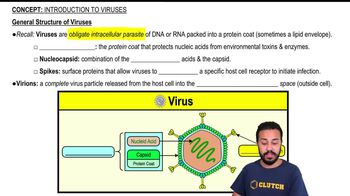
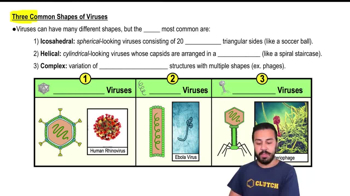
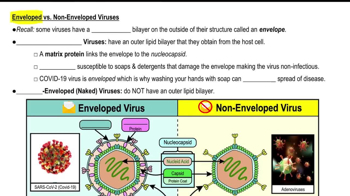
Capsids protect viral genomes, envelopes aid in host cell entry, and spikes help attach viruses to host cells.
Viruses can have double-stranded DNA (dsDNA), single-stranded DNA (ssDNA), positive-sense RNA (ssRNA+), negative-sense RNA (ssRNA-), or retroviral RNA genomes.
dsDNA viruses use host or viral DNA-dependent RNA polymerase to transcribe mRNA; ssDNA viruses first convert to dsDNA before transcription.
ssRNA+ viruses serve directly as mRNA; retroviruses reverse transcribe RNA into DNA, which integrates into the host genome to produce mRNA.
RNA viruses have higher mutation rates due to error-prone RNA polymerases lacking proofreading, leading to faster evolution.
Antigenic drift is gradual mutation accumulation; antigenic shift is abrupt reassortment of viral genes, both affecting influenza virus evolution and outbreaks.
Host range is the spectrum of host species a virus can infect; tropism is the specific cell types a virus can infect within a host.
Attachment, penetration, biosynthesis, assembly, and release of new phage particles causing host cell lysis.
Phage DNA integrates into host genome as a prophage, replicates with host, and can later enter the lytic cycle.
Phage conversion is when a prophage confers new properties to a bacterium, such as toxin production, impacting disease severity.
Attachment, penetration, uncoating, replication, assembly, and release.
Enveloped viruses often enter by fusion and exit by budding; naked viruses enter by endocytosis and exit by cell lysis.
A persistent infection lasts long-term; chronic infections continuously produce virus, latent infections have periods of dormancy.
Oncogenic viruses can cause cancer by integrating into host DNA or altering cell cycle control; examples include HPV and Epstein-Barr virus.
Prions are infectious proteins that are misfolded forms of normal proteins causing neurodegenerative diseases.
Prions cause brain damage leading to spongiform changes and are invariably fatal once symptoms develop.
Scrapie in sheep, bovine spongiform encephalopathy (mad cow disease) in cows, chronic wasting disease in deer and elk.
Creutzfeldt-Jakob disease and variant CJD; transmitted by contaminated tissue, medical procedures, or inherited mutations.