
Ch. 21 - Rickettsias, Chlamydias, Spirochetes, and Vibrios
Bauman - Microbiology with Diseases by Taxonomy 6th Edition
Bauman6th EditionMicrobiology with Diseases by TaxonomyISBN: 9780134832302Non è quello che usi tu?Cambia libro di testo
Capitolo 21, Problema 6

Which of the following diseases would be least likely in rural areas of the United States?
a. Epidemic typhus
b. Rocky Mountain spotted fever
c. Murine typhus
d. Lymphogranuloma venereum

Guida verificata passo dopo passo
1
Step 1: Understand the epidemiology and transmission vectors of each disease listed. This involves knowing which organisms or conditions favor the spread of each disease.
Step 2: Identify the typical environments where each disease is commonly found. For example, epidemic typhus is often associated with crowded, unsanitary conditions and body lice, Rocky Mountain spotted fever is transmitted by ticks commonly found in rural or wooded areas, murine typhus is spread by fleas often linked to urban rats, and lymphogranuloma venereum is a sexually transmitted infection.
Step 3: Analyze the likelihood of each disease occurring in rural areas of the United States based on their transmission vectors and environmental preferences. Consider which diseases are more urban or rural in nature.
Step 4: Compare the diseases to determine which one is least likely to be found in rural areas. For example, diseases associated with urban vectors or conditions would be less common in rural settings.
Step 5: Conclude by selecting the disease least likely to occur in rural areas based on the above analysis.

Risposta video verificata per un problema simile:

Questa soluzione video è stata consigliata dai nostri tutor come utile per risolvere questo problema.
Durata del video:
2m

Concetti chiave

Ecco i concetti essenziali che devi comprendere per rispondere correttamente alla domanda.

Epidemiology and Transmission of Vector-Borne Diseases

Understanding how diseases like epidemic typhus and Rocky Mountain spotted fever are transmitted by vectors such as lice and ticks is crucial. These diseases often depend on specific environmental conditions and host-vector interactions common in rural or wilderness areas.
Video consigliato:
04:57
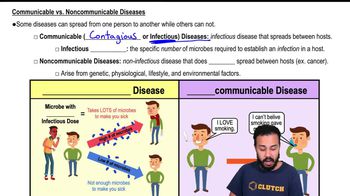
Communicable vs. Noncommunicable Diseases

Geographical Distribution and Habitat Preferences of Disease Vectors

Different vectors thrive in distinct environments; for example, ticks that transmit Rocky Mountain spotted fever are prevalent in rural, wooded areas, while fleas transmitting murine typhus are more common in urban or suburban settings. Recognizing these patterns helps predict disease occurrence.
Video consigliato:
04:57
Communicable vs. Noncommunicable Diseases

Modes of Transmission and Social Factors in Disease Spread

Lymphogranuloma venereum is a sexually transmitted infection, less influenced by rural or urban settings but more by social and behavioral factors. Differentiating diseases by transmission mode aids in understanding their likelihood in specific populations or areas.
Video consigliato:
04:57
Communicable vs. Noncommunicable Diseases