Ch. 5 - Microbial Metabolism
Bauman - Microbiology with Diseases by Taxonomy 6th Edition
Bauman6th EditionMicrobiology with Diseases by TaxonomyISBN: 9780134832302Non è quello che usi tu?Cambia libro di testo
Capitolo 5, Problema 4

_______ is a cyclic series of eight reactions involved in the catabolism of acetyl-CoA that yields eight molecules of NADH and two molecules of FADH2.

Guida verificata passo dopo passo
1
Identify the biochemical pathway described: it is a cyclic series of eight reactions involved in the catabolism of acetyl-CoA.
Recall that this pathway produces high-energy electron carriers, specifically eight molecules of NADH and two molecules of FADH\_2, which are crucial for cellular respiration.
Understand that the pathway is central to aerobic metabolism and takes place in the mitochondrial matrix of eukaryotic cells.
Recognize that the pathway is commonly known as the citric acid cycle or Krebs cycle, named after Hans Krebs who elucidated it.
Summarize that the citric acid cycle oxidizes acetyl-CoA to CO\_2 while generating NADH and FADH\_2, which then feed electrons into the electron transport chain for ATP production.

Risposta video verificata per un problema simile:

Questa soluzione video è stata consigliata dai nostri tutor come utile per risolvere questo problema.
Durata del video:
2m

Concetti chiave

Ecco i concetti essenziali che devi comprendere per rispondere correttamente alla domanda.

Citric Acid Cycle (Krebs Cycle)

The citric acid cycle is a series of eight enzyme-catalyzed reactions that oxidize acetyl-CoA to produce energy-rich molecules. It generates NADH and FADH2, which are essential for the electron transport chain. This cycle is central to cellular respiration and occurs in the mitochondrial matrix.
Video consigliato:
01:37
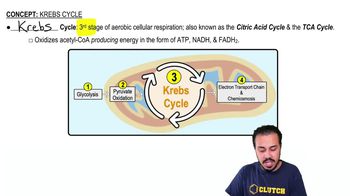
Krebs Cycle

Acetyl-CoA

Acetyl-CoA is a key metabolic intermediate formed from carbohydrates, fats, and proteins. It donates a two-carbon acetyl group to the citric acid cycle, initiating the process of energy extraction through oxidation. Its role is crucial for linking glycolysis and the citric acid cycle.
Video consigliato:
04:14
Histone Acetylation

NADH and FADH2 Production

NADH and FADH2 are electron carriers produced during the citric acid cycle. They store high-energy electrons that are later transferred to the electron transport chain to drive ATP synthesis. Their generation is vital for efficient energy production in aerobic respiration.
Video consigliato:
01:16
Chemical Preservation of Perishable Products