Ch. 11 - Innate Immunity
Norman-McKay- Microbiology: Basic and Clinical Principles 2nd Edition
Norman-McKay2nd EditionMicrobiology: Basic and Clinical PrinciplesISBN: 9780137661619Non è quello che usi tu?Cambia libro di testo
Capitolo 7, Problema 15

Label the following as either primary or secondary lymphoid tissues:Spleen, lymph node, adenoids, thymus, tonsils, bone marrow

Guida verificata passo dopo passo
1
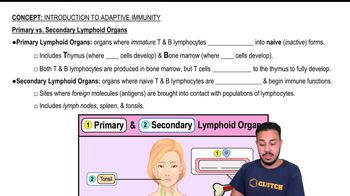
Understand the difference between primary and secondary lymphoid tissues: Primary lymphoid tissues are where lymphocytes (B cells and T cells) mature and develop, while secondary lymphoid tissues are sites where mature lymphocytes become activated by encountering antigens.
Identify the primary lymphoid tissues: These include the bone marrow, where B cells mature, and the thymus, where T cells mature.
Identify the secondary lymphoid tissues: These are sites where immune responses are initiated and include the spleen, lymph nodes, adenoids, and tonsils.
Label each tissue accordingly: Bone marrow and thymus as primary lymphoid tissues; spleen, lymph nodes, adenoids, and tonsils as secondary lymphoid tissues.
Review the functional roles of each tissue to reinforce the classification: For example, the spleen filters blood and traps blood-borne antigens, lymph nodes filter lymph, and adenoids and tonsils protect the entry points of the respiratory and digestive tracts.

Risposta video verificata per un problema simile:

Questa soluzione video è stata consigliata dai nostri tutor come utile per risolvere questo problema.
Durata del video:
3m

Concetti chiave

Ecco i concetti essenziali che devi comprendere per rispondere correttamente alla domanda.

Primary Lymphoid Tissues

Primary lymphoid tissues are where lymphocytes are generated and mature. The bone marrow produces all blood cells including B lymphocytes, while the thymus is where T lymphocytes mature. These tissues are essential for the initial development of immune cells before they migrate to secondary sites.
Video consigliato:
04:58
Primary vs. Secondary Lymphoid Organs

Secondary Lymphoid Tissues

Secondary lymphoid tissues are sites where mature lymphocytes become activated by encountering antigens. These include lymph nodes, spleen, tonsils, and adenoids. They provide an environment for immune cells to interact, proliferate, and initiate immune responses.
Video consigliato:
04:58
Primary vs. Secondary Lymphoid Organs

Functions of Specific Lymphoid Organs

Each lymphoid organ has a specialized role: the spleen filters blood and responds to blood-borne pathogens; lymph nodes filter lymph and trap antigens from tissues; tonsils and adenoids protect the entry points of the respiratory and digestive tracts. Understanding these functions helps classify them as primary or secondary.
Video consigliato:
04:58
Primary vs. Secondary Lymphoid Organs