Ch. 11 - Innate Immunity
Norman-McKay- Microbiology: Basic and Clinical Principles 2nd Edition
Norman-McKay2nd EditionMicrobiology: Basic and Clinical PrinciplesISBN: 9780137661619Non è quello che usi tu?Cambia libro di testo
Capitolo 7, Problema 18

Why is innate immunity considered a generalized defense?

Guida verificata passo dopo passo
1
Understand the definition of innate immunity: it is the body's first line of defense against pathogens and is present from birth.
Recognize that innate immunity responds to pathogens in a non-specific manner, meaning it does not target specific microbes but rather a broad range of potential threats.
Identify the components of innate immunity, such as physical barriers (skin, mucous membranes), chemical barriers (acidic pH, enzymes), and cellular defenses (phagocytic cells like macrophages and neutrophils).
Note that innate immune responses are rapid and do not require prior exposure to a pathogen to be activated.
Conclude that innate immunity is considered generalized because it provides a broad, immediate defense mechanism without the need for pathogen-specific recognition or memory.

Risposta video verificata per un problema simile:

Questa soluzione video è stata consigliata dai nostri tutor come utile per risolvere questo problema.
Durata del video:
6m

Concetti chiave

Ecco i concetti essenziali che devi comprendere per rispondere correttamente alla domanda.

Innate Immunity

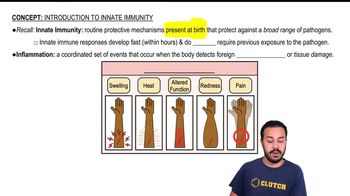
Innate immunity is the body's first line of defense against pathogens, providing immediate but non-specific protection. It includes physical barriers like skin, chemical barriers like enzymes, and immune cells that recognize common features of microbes.
Video consigliato:
02:30
Introduction to Innate Immunity

Generalized Defense Mechanism

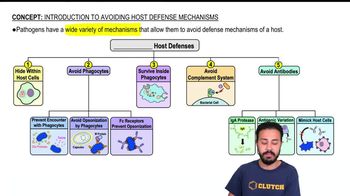
A generalized defense targets broad categories of pathogens rather than specific ones. Innate immunity responds to common molecular patterns found on many microbes, allowing it to act quickly without prior exposure to the pathogen.
Video consigliato:
01:59
Introduction to Avoiding Host Defense Mechanisms

Pattern Recognition Receptors (PRRs)

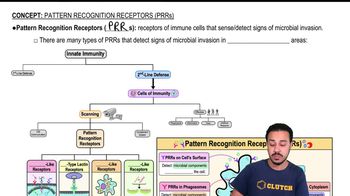
PRRs are molecules on innate immune cells that detect pathogen-associated molecular patterns (PAMPs). This recognition triggers immune responses against a wide range of microbes, explaining why innate immunity is generalized rather than specific.
Video consigliato:
04:24
Pattern Recognition Receptors
Pratica correlata
Domanda del libro di testo

Which of the following shows a correct chronological order of events in inflammation?

a. Neutrophil recruitment, macrophage recruitment, vascular changes, resolution

b. Vascular changes, resolution, neutrophil recruitment, macrophage recruitment

c. Vascular changes, macrophage recruitment, neutrophil recruitment, resolution

d. Vascular changes, macrophage recruitment, resolution, neutrophil recruitment

e. Vascular changes, neutrophil recruitment, macrophage recruitment, resolution

1277
views
Domanda del libro di testo

All of the following defend the eyes EXCEPT:

a. tears.

b. lysozyme.

c. several corneal epithelial layers.

d. a hard external layer encasing the entire eyeball, including the cornea.

e. lactoferrin.

1410
views
Domanda del libro di testo

Which of the following is a chemical defense found in tears? Select all that apply.

a. Water

b. Lysozyme

c. Antimicrobial peptides

d. Neutrophils

1399
views
Domanda del libro di testo

Select all the false statements about fever.

a. It is generated by pyrogens

b. It is an innate immune defense

c. It is accompanied by a decrease in metabolism

d. It can be reduced by anti-inflammatory drugs

e. It can accompany inflammation

1406
views
Domanda del libro di testo

Why are vascular changes in early inflammation considered central to generating inflammation’s cardinal signs?

1359
views
Domanda del libro di testo

Which of the following is false regarding histamine?

a. Histamine is a vasodilator

b. Histamine increases vascular permeability

c. Histamine is a pro-inflammatory factor

d. Histamine is a pyrogen

e. Histamine is released by leukocytes

1431
views