Ch. 12 - Adaptive Immunity
Norman-McKay- Microbiology: Basic and Clinical Principles 2nd Edition
Norman-McKay2nd EditionMicrobiology: Basic and Clinical PrinciplesISBN: 9780137661619Non è quello che usi tu?Cambia libro di testo
Capitolo 8, Problema 2

In which of the following scenarios would administering immunoglobulins be useful? Select all that apply.
a. To neutralize a toxin
b. To aid a patient who is immune compromised
c. After venom exposure
d. To block IgM from crossing the placenta
e. To protect a premature infant from respiratory syncytial virus

Guida verificata passo dopo passo
1
Step 1: Understand what immunoglobulins are. Immunoglobulins (antibodies) are proteins produced by the immune system that recognize and neutralize pathogens such as bacteria, viruses, and toxins. Administering immunoglobulins provides passive immunity by supplying ready-made antibodies.
Step 2: Analyze option (a) 'To neutralize a toxin'. Immunoglobulins can be used to neutralize toxins, such as in cases of tetanus or botulism, by binding to the toxin and preventing it from causing harm. This is a classic use of immunoglobulin therapy.
Step 3: Analyze option (b) 'To aid a patient who is immune compromised'. Immunoglobulins can provide passive immunity to immune-compromised patients who cannot produce sufficient antibodies themselves, helping to protect them from infections.
Step 4: Analyze option (c) 'After venom exposure'. Immunoglobulins, specifically antivenoms, are used to neutralize venom from bites or stings by binding to venom components, preventing their toxic effects.
Step 5: Analyze options (d) and (e). Option (d) 'To block IgM from crossing the placenta' is not applicable because IgM does not cross the placenta; only IgG does. Option (e) 'To protect a premature infant from respiratory syncytial virus' is a valid use of immunoglobulins, as passive immunization can protect vulnerable infants from RSV infection.

Risposta video verificata per un problema simile:

Questa soluzione video è stata consigliata dai nostri tutor come utile per risolvere questo problema.
Durata del video:
3m

Concetti chiave

Ecco i concetti essenziali che devi comprendere per rispondere correttamente alla domanda.

Passive Immunization with Immunoglobulins

Passive immunization involves administering pre-formed antibodies (immunoglobulins) to provide immediate but temporary protection against specific pathogens or toxins. It is useful in situations where rapid immunity is needed, such as toxin neutralization or post-exposure prophylaxis, without waiting for the body to produce its own antibodies.
Video consigliato:
05:05
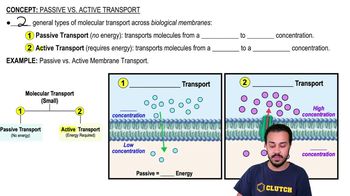
Passive vs. Active Transport

Indications for Immunoglobulin Therapy

Immunoglobulin therapy is indicated for neutralizing toxins (e.g., tetanus), treating immune-compromised patients who cannot mount an adequate immune response, and providing protection after exposure to certain venoms or viruses. It is not used to block antibody transfer across the placenta or as a vaccine substitute.
Video consigliato:
03:48
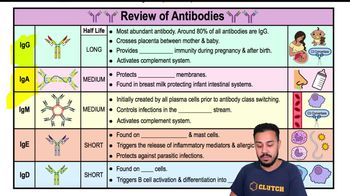
Review Table of Immunoglobin Classes

Limitations of Immunoglobulin Use

Immunoglobulins do not prevent the transfer of maternal IgM antibodies across the placenta, as IgM does not cross the placenta naturally. Also, immunoglobulin administration provides temporary immunity and is not a replacement for active immunization or long-term protection, especially in premature infants who may require additional interventions.
Video consigliato:
02:58
Limitations to Koch's Postulates