The distinct feature of an antigen that stimulates an adaptive immune response is called a(n) ________________.
Ch. 12 - Adaptive Immunity

Norman-McKay2nd EditionMicrobiology: Basic and Clinical PrinciplesISBN: 9780137661619Non è quello che usi tu?Cambia libro di testo
Capitolo 8, Problema 11
Where do T cells undergo self-tolerance selection?
Guida verificata passo dopo passo1
Understand that T cells develop in the thymus, an organ located in the upper chest, where they undergo processes to ensure they do not react against the body's own tissues.
Recognize that self-tolerance selection involves two main processes: positive selection and negative selection, both occurring in different regions of the thymus.
Identify that positive selection occurs in the thymic cortex, where T cells that can recognize self-MHC molecules are selected for survival.
Know that negative selection takes place primarily in the thymic medulla, where T cells that strongly bind to self-antigens presented by medullary thymic epithelial cells and dendritic cells are eliminated to prevent autoimmunity.
Conclude that the overall process of self-tolerance selection, especially the elimination of self-reactive T cells, occurs mainly in the thymus, involving both the cortex and medulla regions.

Risposta video verificata per un problema simile:
Questa soluzione video è stata consigliata dai nostri tutor come utile per risolvere questo problema.
Durata del video:
2mConcetti chiave
Ecco i concetti essenziali che devi comprendere per rispondere correttamente alla domanda.
T Cell Development
T cells develop from hematopoietic stem cells in the bone marrow but mature primarily in the thymus. During this process, immature T cells undergo various stages of differentiation to become functional immune cells capable of recognizing antigens.
Video consigliato:
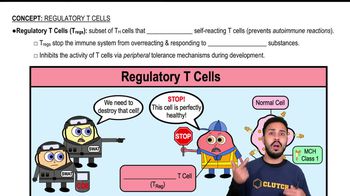
Regulatory T Cells
Self-Tolerance Selection
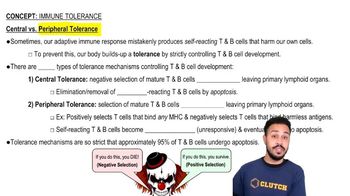
Self-tolerance selection is a critical process that eliminates or inactivates T cells that strongly recognize self-antigens, preventing autoimmune reactions. This selection ensures that T cells do not attack the body's own tissues.
Video consigliato:
Central vs. Peripheral Tolerance
Thymic Selection (Positive and Negative Selection)
In the thymus, T cells undergo positive selection to ensure they can recognize self-MHC molecules, and negative selection to remove those that bind too strongly to self-antigens. This dual process establishes self-tolerance and functional T cell repertoires.
Video consigliato:
Selective Media
Pratica correlata
Domanda del libro di testo
1399
views
Domanda del libro di testo
Choose the false statement about T cytotoxic cells.
a. They stimulate B cells
b. They destroy virus-infected cells
c. They destroy cancer cells
d. They are activated by MHC I bound to antigens on APCs
e. They mediate the cellular branch of adaptive immunity
1273
views
Domanda del libro di testo
Which of the following is not a function of antibodies?
a. Opsonization
b. Activating complement proteins
c. Activating T helper cells
d. Enhancing phagocytosis
e. Antigen neutralization
1761
views
Domanda del libro di testo
Compare and contrast T-dependent and T-independent antigens.
1427
views
Domanda del libro di testo
T helper cells activate B cells to become ________________, which make ________________.
1520
views
Domanda del libro di testo
Match the cell to its stated feature. Some features will be assigned more than once.
1494
views