What is the general goal of treatments used for autoimmune disorders?
Ch. 13 - Immune System Disorders

Norman-McKay2nd EditionMicrobiology: Basic and Clinical PrinciplesISBN: 9780137661619Non è quello che usi tu?Cambia libro di testo
Capitolo 9, Problema 15
Which of the following is (are) true regarding primary immunodeficiencies? Select all that apply.
a. These disorders tend to be present from birth.
b. These disorders are also called congenital immunodeficiencies.
c. These disorders are more common in elderly patients.
d. Patients with these disorders may not have a familial history of immunodeficiencies.
e. Patients with these disorders tend to experience recurring, persistent, and severe infections, often caused by uncommon agents.
Guida verificata passo dopo passo1
Step 1: Understand the definition of primary immunodeficiencies (PIDs). These are genetic or congenital disorders that affect the immune system's ability to function properly, typically present from birth.
Step 2: Analyze option (a): Since PIDs are genetic or congenital, they tend to be present from birth. This aligns with the definition of primary immunodeficiencies.
Step 3: Analyze option (b): Because PIDs are present from birth, they are also called congenital immunodeficiencies, making this statement true.
Step 4: Analyze option (c): PIDs are not more common in elderly patients; rather, secondary immunodeficiencies (due to aging, infections, or other causes) are more common in that group. So this statement is false.
Step 5: Analyze options (d) and (e): Patients with PIDs may or may not have a familial history due to variable inheritance patterns, so (d) can be true. Also, these patients often experience recurring, persistent, and severe infections, often caused by uncommon pathogens, making (e) true.

Risposta video verificata per un problema simile:
Questa soluzione video è stata consigliata dai nostri tutor come utile per risolvere questo problema.
Durata del video:
2mConcetti chiave
Ecco i concetti essenziali che devi comprendere per rispondere correttamente alla domanda.
Primary Immunodeficiencies
Primary immunodeficiencies are genetic disorders that impair the immune system's ability to fight infections. They are usually present from birth and result from inherited or spontaneous mutations affecting immune cells or molecules.
Video consigliato:
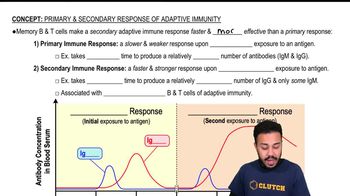
Primary and Secondary Response of Adaptive Immunity
Clinical Presentation and Epidemiology
Patients with primary immunodeficiencies often experience recurrent, persistent, or severe infections, sometimes caused by unusual pathogens. These disorders are typically diagnosed in childhood but can vary in severity and may lack a clear family history.
Video consigliato:
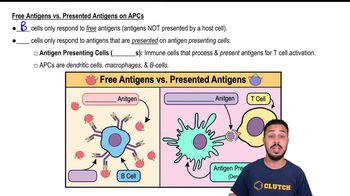
Free Antigens vs. Presented Antigens on APCs
Terminology: Congenital vs. Acquired Immunodeficiencies
Primary immunodeficiencies are also known as congenital immunodeficiencies because they are present at birth due to genetic causes. In contrast, secondary or acquired immunodeficiencies develop later in life due to external factors like infections or aging.
Video consigliato:
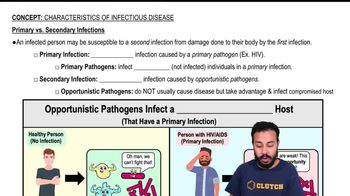
Primary vs. Secondary Infections
Pratica correlata
Domanda del libro di testo
1046
views
Domanda del libro di testo
Imagine that one of your patients is an emergency medical technician who has a family history of autoimmune disorders and allergy, but she does not currently suffer from either. Which of the following is (are) most likely true of your patient? Select all that apply.
a. She is at an increased risk for cancer
b. She is at an increased risk for type I hypersensitivities
c. She is at an increased risk for type III hypersensitivities
d. She is at an increased risk for latex hypersensitivity
e. She is at an increased risk for immunosuppression
939
views
Domanda del libro di testo
Which types of white blood cells are most likely to be involved in type I hypersensitivities? Select all that apply.
a. T helper cells
b. T cytotoxic cells
c. Basophils
d. Macrophages
e. Mast cells
1077
views