Ch. 16 - Respiratory System Infections
Norman-McKay- Microbiology: Basic and Clinical Principles 2nd Edition
Norman-McKay2nd EditionMicrobiology: Basic and Clinical PrinciplesISBN: 9780137661619Non è quello che usi tu?Cambia libro di testo
Capitolo 12, Problema 11

Indicate the true statements, and then correct the false statements so that they are true.
a. The most common viruses that cause human respiratory system infections are cold viruses.
b. Viruses can be treated with antibiotics.
c. People who have been exposed to cold and/or wet conditions are statistically more likely to develop a cold.
d. Many respiratory illnesses that are not caused by influenza viruses have flu-like symptoms.
e. The flu vaccine is not recommended for children under 2 years of age.
f. Pneumonia is a rare healthcare-acquired infection.

Guida verificata passo dopo passo
1
Step 1: Evaluate statement (a): 'The most common viruses that cause human respiratory system infections are cold viruses.' Understand that 'cold viruses' typically refer to rhinoviruses, which are indeed the most common cause of upper respiratory infections. Confirm that this statement is true.
Step 2: Evaluate statement (b): 'Viruses can be treated with antibiotics.' Recall that antibiotics target bacteria, not viruses. Since antibiotics are ineffective against viruses, this statement is false. Correct it to: 'Viruses cannot be treated with antibiotics; antiviral medications are used instead for some viral infections.'
Step 3: Evaluate statement (c): 'People who have been exposed to cold and/or wet conditions are statistically more likely to develop a cold.' Consider scientific evidence showing that exposure to cold or wet conditions alone does not increase the likelihood of catching a cold. This statement is false. Correct it to: 'Exposure to cold and/or wet conditions does not statistically increase the likelihood of developing a cold; colds are caused by viral infections transmitted from person to person.'
Step 4: Evaluate statement (d): 'Many respiratory illnesses that are not caused by influenza viruses have flu-like symptoms.' Recognize that symptoms such as fever, cough, and body aches can be caused by various respiratory viruses besides influenza. This statement is true.
Step 5: Evaluate statement (e): 'The flu vaccine is not recommended for children under 2 years of age.' Check current vaccination guidelines, which recommend flu vaccination starting at 6 months of age. This statement is false. Correct it to: 'The flu vaccine is recommended for children 6 months of age and older.' Also, evaluate statement (f): 'Pneumonia is a rare healthcare-acquired infection.' Understand that healthcare-associated pneumonia is actually a common and serious infection in healthcare settings. This statement is false. Correct it to: 'Pneumonia is a common healthcare-acquired infection.'

Risposta video verificata per un problema simile:

Questa soluzione video è stata consigliata dai nostri tutor come utile per risolvere questo problema.
Durata del video:
2m

Concetti chiave

Ecco i concetti essenziali che devi comprendere per rispondere correttamente alla domanda.

Common Viruses Causing Respiratory Infections

The most frequent viruses causing human respiratory infections include rhinoviruses, often called cold viruses, as well as influenza viruses and coronaviruses. Rhinoviruses are the primary cause of the common cold, which is the most prevalent respiratory illness worldwide.
Video consigliato:
03:19
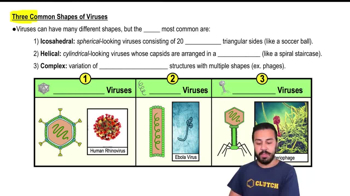
Three Common Shapes of Viruses

Antibiotic Use and Viral Infections

Antibiotics are designed to kill or inhibit bacteria and are ineffective against viruses. Viral infections, such as colds and flu, cannot be treated with antibiotics; instead, antiviral medications or supportive care are used depending on the virus.
Video consigliato:
05:12
Persistent Viral Infections

Epidemiology and Prevention of Respiratory Illnesses

Exposure to cold or wet conditions does not directly cause colds, which are viral infections, but may influence susceptibility. Vaccination, such as the flu vaccine, is recommended for most age groups to prevent influenza, and healthcare-associated infections like pneumonia are common, not rare.
Video consigliato:
04:59
1) Viruses Prevent Antiviral Effects of AVPs
Pratica correlata
Domanda del libro di testo

The __________ vaccine is a childhood vaccine to protect against tetanus, diphtheria, and pertussis; in contrast, the __________ vaccine is a booster shot recommended for adolescents and adults to protect against tetanus, diphtheria, and pertussis.

1080
views
Domanda del libro di testo

List the three stages of pertussis, and provide some general characteristics of each stage.

879
views
Domanda del libro di testo

Match the following:

885
views
Domanda del libro di testo

Give two reasons why the bacillus Calmette–Guérin (BCG) vaccine is not routinely recommended in the United States to prevent tuberculosis.

1249
views
Domanda del libro di testo

From the following list, select all of the diseases that antibiotics do not directly cure.

a. Hanta pulmonary syndrome

b. Streptococcus pneumoniae

c. Colds

d. Influenza

e. Haemophilus influenzae

f. COVID-19

g. Legionellosis

h. Tularemia

1097
views
Domanda del libro di testo

Choose the general agent of the disease (select ONE choice of agent from the options after each illness):

a. Pneumococcal pneumonia is caused by a (virus, bacterium, fungus).

b. Pneumocystis pneumonia is caused by a (virus, bacterium, fungus).

c. Tuberculosis is caused by a (virus, bacterium, fungus).

d. Histoplasmosis is caused by a (virus, bacterium, fungus).

e. Influenza is caused by a (virus, bacterium, fungus).

f. Colds are caused by (viruses, bacteria, fungi).

g. Coccidioidomycosis is caused by a (virus, bacterium, fungus).

h. Diphtheria is caused by a (virus, bacterium, fungus).

i. Pertussis is caused by a (virus, bacterium, fungus).

j. Scarlet fever is caused by a (virus, bacterium, fungus).

k. Legionellosis is caused by a (virus, bacterium, fungus).

l. Q fever is caused by a (virus, bacterium, fungus).

m. Hanta pulmonary syndrome is caused by a (virus, bacterium, fungus).

n. Streptococcal pharyngitis is caused by a (virus, bacterium, fungus).

26
views