Ch. 2 - Biochemistry Basics
Norman-McKay- Microbiology: Basic and Clinical Principles 2nd Edition
Norman-McKay2nd EditionMicrobiology: Basic and Clinical PrinciplesISBN: 9780137661619Non è quello che usi tu?Cambia libro di testo
Capitolo 1, Problema 2

What ions result when hydrogen donates one electron to fluorine?

Guida verificata passo dopo passo
1
Identify the elements involved: hydrogen (H) and fluorine (F). Hydrogen has one electron, and fluorine has seven electrons in its outer shell.
Understand the electron transfer: when hydrogen donates one electron, it loses an electron and becomes a positively charged ion (cation).
Determine the ion formed by hydrogen after losing an electron: it becomes a hydrogen ion, represented as \(\mathrm{H}^{+}\).
Determine the ion formed by fluorine after gaining one electron: it gains an electron to complete its outer shell, becoming a negatively charged ion (anion), represented as \(\mathrm{F}^{-}\).
Conclude that the ions resulting from this electron transfer are \(\mathrm{H}^{+}\) (hydrogen ion) and \(\mathrm{F}^{-}\) (fluoride ion).

Risposta video verificata per un problema simile:

Questa soluzione video è stata consigliata dai nostri tutor come utile per risolvere questo problema.
Durata del video:
3m

Concetti chiave

Ecco i concetti essenziali che devi comprendere per rispondere correttamente alla domanda.

Ionic Bond Formation

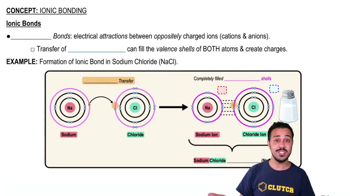
Ionic bonds form when one atom donates electrons to another, resulting in oppositely charged ions that attract each other. In this process, the donor atom becomes a positively charged ion (cation), and the acceptor becomes a negatively charged ion (anion).
Video consigliato:
06:07
Ionic Bonds

Electron Transfer Between Hydrogen and Fluorine

When hydrogen donates one electron to fluorine, hydrogen loses an electron and becomes a hydrogen ion (H⁺), while fluorine gains an electron and becomes a fluoride ion (F⁻). This electron transfer leads to the formation of ions with opposite charges.
Video consigliato:
05:03
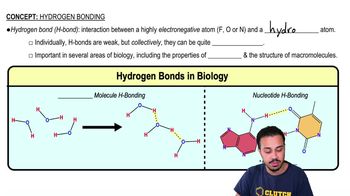
Hydrogen Bonding

Charge and Ion Notation

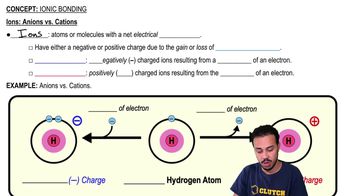
Ions are represented with their chemical symbol followed by a superscript indicating their charge. For example, H⁺ indicates a hydrogen ion with a positive charge, and F⁻ indicates a fluoride ion with a negative charge, reflecting the gain or loss of electrons.
Video consigliato:
04:34
Ionic Bonding