Ch. 21 - Cardiovascular and Lymphatic Infections
Norman-McKay- Microbiology: Basic and Clinical Principles 2nd Edition
Norman-McKay2nd EditionMicrobiology: Basic and Clinical PrinciplesISBN: 9780137661619Non è quello che usi tu?Cambia libro di testo
Capitolo 17, Problema 2

First label the following diseases as bacterial, viral, or protozoan, and then indicate which ones are vectorborne infections: dengue fever, AIDS, chikungunya, Lyme disease, malaria.

Guida verificata passo dopo passo
1
Step 1: Identify the type of pathogen responsible for each disease. Recall that bacterial diseases are caused by bacteria, viral diseases by viruses, and protozoan diseases by protozoa (single-celled eukaryotic organisms).
Step 2: Classify each disease accordingly: - Dengue fever: caused by a virus (Dengue virus). - AIDS: caused by a virus (Human Immunodeficiency Virus, HIV). - Chikungunya: caused by a virus (Chikungunya virus). - Lyme disease: caused by bacteria (Borrelia burgdorferi). - Malaria: caused by protozoa (Plasmodium species).
Step 3: Understand what vectorborne infections are. Vectorborne diseases are transmitted to humans through the bite of infected arthropods such as mosquitoes, ticks, or fleas.
Step 4: Determine which diseases are vectorborne by identifying their vectors: - Dengue fever: transmitted by Aedes mosquitoes (vectorborne). - AIDS: transmitted primarily through bodily fluids, not vectorborne. - Chikungunya: transmitted by Aedes mosquitoes (vectorborne). - Lyme disease: transmitted by ticks (vectorborne). - Malaria: transmitted by Anopheles mosquitoes (vectorborne).
Step 5: Summarize the classification and vectorborne status for each disease to complete the problem.

Risposta video verificata per un problema simile:

Questa soluzione video è stata consigliata dai nostri tutor come utile per risolvere questo problema.
Durata del video:
2m

Concetti chiave

Ecco i concetti essenziali che devi comprendere per rispondere correttamente alla domanda.

Classification of Infectious Diseases by Pathogen Type

Infectious diseases are categorized based on the type of causative agent: bacteria, viruses, or protozoa. Understanding these categories helps identify the nature of the disease and guides treatment options. For example, bacterial diseases are caused by bacteria, viral diseases by viruses, and protozoan diseases by single-celled eukaryotic organisms.
Video consigliato:
05:09
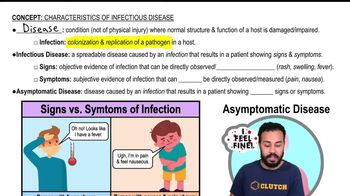
Intro to Characteristics of Infectious Disease

Vectorborne Diseases

Vectorborne diseases are infections transmitted to humans through carriers called vectors, often arthropods like mosquitoes or ticks. Recognizing which diseases are vectorborne is crucial for understanding their transmission dynamics and implementing control measures. Examples include malaria transmitted by mosquitoes and Lyme disease transmitted by ticks.
Video consigliato:
04:57
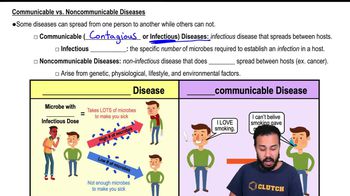
Communicable vs. Noncommunicable Diseases

Examples of Specific Diseases and Their Classification

Familiarity with common diseases and their classifications aids in quick identification. Dengue fever and chikungunya are viral and mosquito-borne; AIDS is viral but not vectorborne; Lyme disease is bacterial and tick-borne; malaria is protozoan and mosquito-borne. This knowledge links disease characteristics to their causative agents and transmission.
Video consigliato:
04:57
Communicable vs. Noncommunicable Diseases