Ch. 4 - Introduction to Eukaryotic Cells
Norman-McKay- Microbiology: Basic and Clinical Principles 2nd Edition
Norman-McKay2nd EditionMicrobiology: Basic and Clinical PrinciplesISBN: 9780137661619Non è quello che usi tu?Cambia libro di testo
Capitolo 2, Problema 10

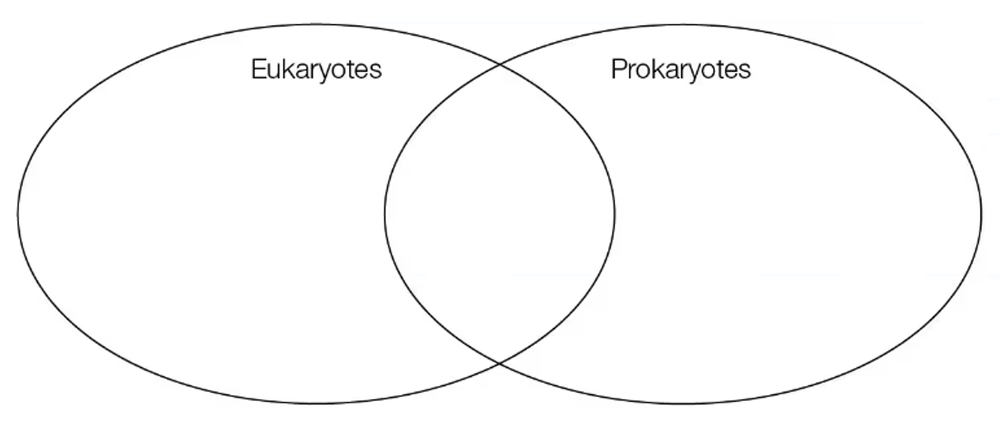
Complete the Venn diagram that compares and contrasts prokaryotes and eukaryotes.
Blank Venn diagram with two overlapping circles labeled Eukaryotes and Prokaryotes for comparing cell characteristics.

Guida verificata passo dopo passo
1
Identify the defining characteristics of prokaryotes, such as the absence of a nucleus, presence of a single circular chromosome, lack of membrane-bound organelles, and generally smaller cell size.
List the defining characteristics of eukaryotes, including the presence of a true nucleus, multiple linear chromosomes, membrane-bound organelles like mitochondria and the endoplasmic reticulum, and generally larger cell size.
Determine the shared features between prokaryotes and eukaryotes, such as having a plasma membrane, ribosomes for protein synthesis, DNA as genetic material, and the ability to carry out basic metabolic processes.
Organize these characteristics into the Venn diagram by placing unique prokaryotic traits in the prokaryote-only section, unique eukaryotic traits in the eukaryote-only section, and shared traits in the overlapping middle section.
Review the completed Venn diagram to ensure all key similarities and differences are accurately represented, helping to visualize the fundamental distinctions and commonalities between these two cell types.

Risposta video verificata per un problema simile:

Questa soluzione video è stata consigliata dai nostri tutor come utile per risolvere questo problema.
Durata del video:
2m

Concetti chiave

Ecco i concetti essenziali che devi comprendere per rispondere correttamente alla domanda.

Cellular Structure of Prokaryotes and Eukaryotes

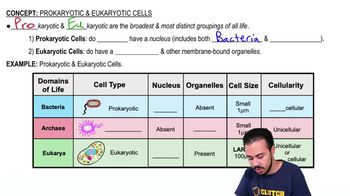
Prokaryotes are unicellular organisms without a nucleus or membrane-bound organelles, while eukaryotes have a defined nucleus and various organelles. Understanding these structural differences is essential for comparing their cellular organization.
Video consigliato:
05:54
Prokaryotic & Eukaryotic Cells

Genetic Material Organization

In prokaryotes, DNA is typically circular and located in the nucleoid region, whereas eukaryotic DNA is linear and enclosed within the nucleus. This distinction affects gene expression and replication processes.
Video consigliato:
01:28
Genetic Code

Reproduction and Metabolic Diversity

Prokaryotes reproduce mainly by binary fission and exhibit diverse metabolic pathways, including anaerobic and photosynthetic processes. Eukaryotes reproduce sexually or asexually and have more complex metabolic systems, which is important for understanding their biological roles.
Video consigliato:
02:17
Introduction to Metabolism