Ch. 4 - Introduction to Eukaryotic Cells
Norman-McKay- Microbiology: Basic and Clinical Principles 2nd Edition
Norman-McKay2nd EditionMicrobiology: Basic and Clinical PrinciplesISBN: 9780137661619Non è quello che usi tu?Cambia libro di testo
Capitolo 2, Problema 2

Which of the following are not characteristics of eukaryotes? Select all that apply.
a. They are generally simpler than prokaryotes.
b. They can be multicellular.
c. They all have a nucleus.
d. They tend to have multiple chromosomes.
e. They can have a cell wall.
f. They include pathogens.
g. They divide by mitosis.
h. They make up the Domain Archaea.
i. They make up the Domain Bacteria.
j. They make up the Domain Eukarya.

Guida verificata passo dopo passo
1
Step 1: Understand the definition of eukaryotes. Eukaryotic cells have a true nucleus enclosed by a nuclear membrane, multiple linear chromosomes, and membrane-bound organelles. They can be unicellular or multicellular organisms.
Step 2: Evaluate each statement against eukaryotic characteristics. For example, statement (a) says 'They are generally simpler than prokaryotes.' Since eukaryotes are typically more complex, this statement is not a characteristic of eukaryotes.
Step 3: Consider statements about domains. Eukaryotes belong to the Domain Eukarya, so statements claiming they make up Domains Archaea or Bacteria (h and i) are incorrect for eukaryotes.
Step 4: Analyze statements about cell division and structure. Eukaryotes divide by mitosis (g), have nuclei (c), and tend to have multiple chromosomes (d). Some eukaryotes have cell walls (e.g., plants and fungi), so that is a characteristic.
Step 5: Summarize which statements do not apply to eukaryotes by identifying those that contradict the known features of eukaryotic cells, such as (a), (h), and (i).

Risposta video verificata per un problema simile:

Questa soluzione video è stata consigliata dai nostri tutor come utile per risolvere questo problema.
Durata del video:
2m

Concetti chiave

Ecco i concetti essenziali che devi comprendere per rispondere correttamente alla domanda.

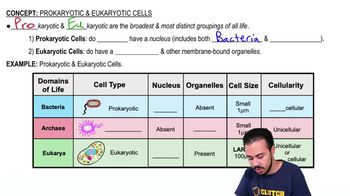
Differences Between Prokaryotes and Eukaryotes

Prokaryotes are simpler, unicellular organisms without a nucleus, while eukaryotes have complex cells with a defined nucleus and membrane-bound organelles. Understanding these structural differences helps distinguish characteristics unique to eukaryotes.
Video consigliato:
05:54
Prokaryotic & Eukaryotic Cells

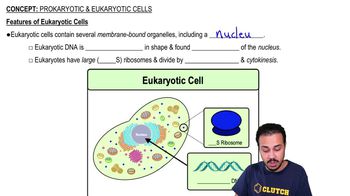
Eukaryotic Cell Features

Eukaryotic cells typically have multiple linear chromosomes, can be multicellular or unicellular, may have cell walls (in plants and fungi), and divide by mitosis. These features contrast with prokaryotes, which usually have a single circular chromosome and divide by binary fission.
Video consigliato:
04:17
Features of Eukaryotic Cells

Biological Classification Domains

Life is classified into three domains: Bacteria and Archaea (both prokaryotic) and Eukarya (eukaryotic). Eukaryotes belong exclusively to the Domain Eukarya, which includes animals, plants, fungi, and protists, while Bacteria and Archaea are prokaryotic domains.
Video consigliato:
02:10
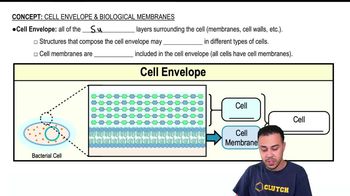
Biological Membranes