Ch. 6 - Viruses and Prions
Norman-McKay- Microbiology: Basic and Clinical Principles 2nd Edition
Norman-McKay2nd EditionMicrobiology: Basic and Clinical PrinciplesISBN: 9780137661619Non è quello che usi tu?Cambia libro di testo
Capitolo 3, Problema 11

Why don’t bacteriophages undergo an “uncoating” step during replication?

Guida verificata passo dopo passo
1
Understand the concept of "uncoating" in viral replication: it refers to the removal of the viral capsid to release the viral genome into the host cell.
Recognize that bacteriophages inject their genetic material directly into the bacterial host cell, unlike many animal viruses that enter the host cell entirely.
Since bacteriophages do not enter the host cell as complete virions, their capsid remains outside the bacterial cell surface during infection.
Because the viral genome is directly delivered into the bacterial cytoplasm, there is no need for a separate uncoating step to release the genome inside the host.
Conclude that the absence of an uncoating step in bacteriophage replication is due to their unique infection mechanism involving direct genome injection rather than whole virion entry.

Risposta video verificata per un problema simile:

Questa soluzione video è stata consigliata dai nostri tutor come utile per risolvere questo problema.
Durata del video:
1m

Concetti chiave

Ecco i concetti essenziali che devi comprendere per rispondere correttamente alla domanda.

Bacteriophage Structure and Genome Delivery

Bacteriophages are viruses that infect bacteria by injecting their genetic material directly into the host cell, leaving the protein coat outside. This direct genome delivery means the viral nucleic acid is already inside the host cytoplasm, eliminating the need for an uncoating step.
Video consigliato:
03:18
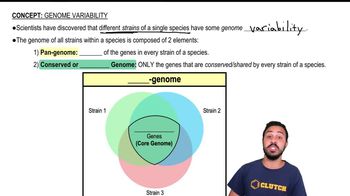
Genome Variability

Uncoating in Viral Replication

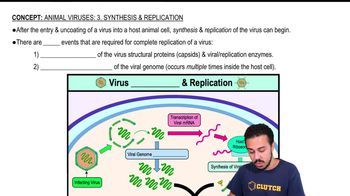
Uncoating is the process where a virus removes its protein coat to release its genome inside a host cell. This step is essential for many animal viruses that enter the cell enclosed in their capsid, but is unnecessary for bacteriophages due to their injection mechanism.
Video consigliato:
05:12
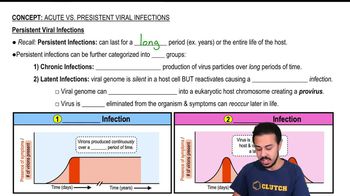
Persistent Viral Infections

Differences Between Animal Viruses and Bacteriophages

Animal viruses typically enter host cells via endocytosis or membrane fusion, requiring uncoating to access the genome. In contrast, bacteriophages inject their genome through the bacterial cell wall, bypassing the need for uncoating and streamlining replication.
Video consigliato:
04:26
Animal Viruses: 3. Synthesis & Replication