Ch. 8 - Microbial Metabolism
Norman-McKay- Microbiology: Basic and Clinical Principles 2nd Edition
Norman-McKay2nd EditionMicrobiology: Basic and Clinical PrinciplesISBN: 9780137661619Non è quello che usi tu?Cambia libro di testo
Capitolo 4, Problema 13

The photo shows an organism growing in glucose fermentation broth. What can you conclude about this specimen with regard to its ability (or lack thereof) to ferment the sugar sucrose? Explain your answer.
<IMAGE>

Guida verificata passo dopo passo
1
Understand that glucose fermentation broth is used to test whether an organism can ferment glucose, producing acid and/or gas as byproducts.
Recognize that the ability to ferment glucose does not necessarily imply the ability to ferment other sugars like sucrose, since different enzymes are required to break down different sugars.
Note that to determine if the organism can ferment sucrose, a separate sucrose fermentation test or broth would be needed, where sucrose is the sole carbohydrate source.
Interpret the results of the glucose fermentation broth: if acid or gas production is observed, it confirms glucose fermentation but does not provide direct information about sucrose fermentation.
Conclude that without specific testing in sucrose broth, no definitive conclusion can be drawn about the organism's ability to ferment sucrose based solely on growth in glucose fermentation broth.

Risposta video verificata per un problema simile:

Questa soluzione video è stata consigliata dai nostri tutor come utile per risolvere questo problema.
Durata del video:
3m

Concetti chiave

Ecco i concetti essenziali che devi comprendere per rispondere correttamente alla domanda.

Glucose Fermentation Test

This test determines if an organism can metabolize glucose anaerobically, producing acid and/or gas. A positive result typically shows a color change in the broth due to acid production, indicating fermentation. Understanding this helps infer the organism's metabolic capabilities with glucose.
Video consigliato:
06:59
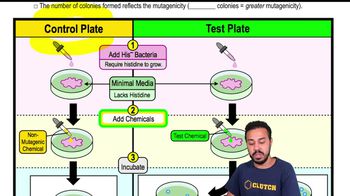
The Ames Test

Sugar Fermentation Specificity

Microorganisms may ferment some sugars but not others, depending on their enzymatic machinery. Fermentation of glucose does not guarantee fermentation of sucrose, as sucrose requires specific enzymes like sucrase to break it down. This concept is key to predicting fermentation of different sugars.
Video consigliato:
01:59
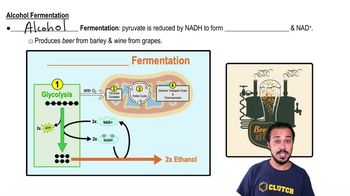
Alcohol Fermentation

Interpreting Fermentation Results for Sucrose

To conclude about sucrose fermentation, one must consider whether the organism possesses enzymes to hydrolyze sucrose into fermentable monosaccharides. Without direct testing in sucrose broth, glucose fermentation alone cannot confirm sucrose fermentation ability, highlighting the need for specific tests.
Video consigliato:
01:59
Alcohol Fermentation
Pratica correlata
Domanda del libro di testo

Rank the following from the most ATP that could be made to the least ATP that could be made:

a. 1 glucose molecule processed via a fermentation pathway (consider that glycolysis is the first stage of the process)

b. A lipid made of glycerol and three 10-carbon fatty acid chains entering cellular respiration

c. 1 glucose molecule entering the Entner–Doudoroff pathway

d. 1 glucose molecule entering cellular respiration

1064
views
Domanda del libro di testo

_______________________ is a process that uses light energy to drive an electron transport chain to make ATP.

1425
views
Domanda del libro di testo

The _______________________ test detects if an organism can convert hydrogen peroxide to water and oxygen. The test result is usually _______________________ in anaerobic microbes and usually _______________________ in aerobic microbes. You know the test is positive by _______________________.

1417
views
1
rank
Domanda del libro di testo

Match the term to the statement. (Some terms will be used more than once.)

1322
views
Domanda del libro di testo

_______________________ is a process that uses energy from nutrients to fuel an electron transport chain to make ATP.

1378
views
Domanda del libro di testo

Use this pathway schematic to answer questions a through d.

a. Which enzyme carries out a redox reaction? In this reaction, what is being reduced and what is being oxidized?

b. Which enzyme would be the most likely to be regulated by feedback inhibition?

c. What is the end product of this pathway?

d. Which enzyme carries out substrate-level phosphorylation?

1126
views