Ch. 10 - Classification of Microorganisms
Tortora - Microbiology: An Introduction 14th Edition
Tortora14th EditionMicrobiology: An IntroductionISBN: 9780138200398Non è quello che usi tu?Cambia libro di testo
Capitolo 6, Problema 2

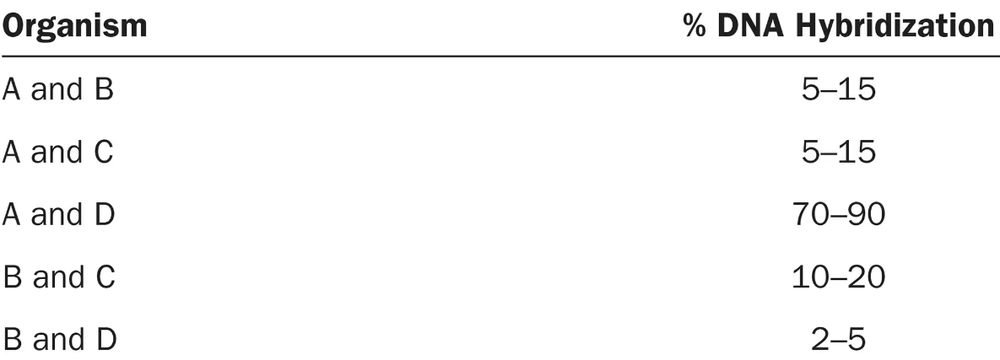
Here is some additional information on the organisms in question 1:
Table showing DNA hybridization percentages between organism pairs, highest similarity between A and D at 70–90%.
Which of these organisms are most closely related? Compare this answer with your response to review question 1.

Guida verificata passo dopo passo
1
Identify the organisms presented in the image or information provided, noting their key characteristics such as morphology, genetic markers, metabolic traits, or other distinguishing features.
Recall or review the criteria used to determine relatedness among microorganisms, such as genetic similarity (e.g., 16S rRNA gene sequences), phenotypic traits, or evolutionary lineage.
Compare the characteristics of each organism pairwise to assess which share the most similarities, focusing on traits that indicate close evolutionary relationships.
Use a phylogenetic tree or similarity matrix if available, or construct a simple comparison table to visualize which organisms cluster together based on shared features.
Conclude which organisms are most closely related based on the highest degree of similarity, and then compare this conclusion with your previous answer from review question 1 to check for consistency or discrepancies.

Risposta video verificata per un problema simile:

Questa soluzione video è stata consigliata dai nostri tutor come utile per risolvere questo problema.
Durata del video:
3m

Concetti chiave

Ecco i concetti essenziali che devi comprendere per rispondere correttamente alla domanda.

Phylogenetic Relationships

Phylogenetic relationships describe the evolutionary connections between organisms, often depicted as a tree showing common ancestors. Understanding these relationships helps determine which organisms share a more recent common ancestor and are thus more closely related.
Video consigliato:
05:59
Symbiotic Relationships

Molecular and Genetic Comparison

Comparing genetic material, such as DNA or RNA sequences, is a key method to assess relatedness among organisms. Similarities in gene sequences or molecular markers indicate closer evolutionary relationships.
Video consigliato:
01:28
Genetic Code

Morphological and Physiological Traits

Physical characteristics and metabolic features can provide clues about organism relatedness. While useful, these traits may be influenced by environmental factors and convergent evolution, so they are often combined with molecular data for accurate classification.
Video consigliato:
02:44
Types of Bacterial Cell Morphology
Pratica correlata
Domanda del libro di testo

Bacillus and Lactobacillus are not in the same order. This indicates that which one of the following is not sufficient to assign an organism to a taxon?

a. Biochemical characteristics

b. Amino acid sequencing

c. Phage typing

d. Serology

e. Morphological characteristics

1479
views
Domanda del libro di testo

Which of the following is false about scientific nomenclature?

a. Each name is specific.

b. Names vary with geographical location.

c. The names are standardized.

d. Each name consists of a genus and specific epithet.

e. It was first designed by Linnaeus.

1652
views
Domanda del libro di testo

Which of the following is used to classify organisms into the Kingdom Fungi?

a. Ability to photosynthesize; possess a cell wall

b. Unicellular; possess cell wall; prokaryotic

c. Unicellular; lacking cell wall; eukaryotic

d. Absorptive; possess cell wall; eukaryotic

e. Ingestive; lacking cell wall; multicellular; prokaryotic

1602
views
Domanda del libro di testo

Which of the following organisms are most closely related? Are any two the same species? On what did you base your answer?

1451
views
Domanda del libro di testo

Bergey’s Manual of Systematics of Archaea and Bacteria differs from Bergey’s Manual of Determinative Bacteriology in that the former

a. Groups bacteria into species

b. Groups bacteria according to phylogenetic relationships

c. Groups bacteria according to pathogenic properties

d. Groups bacteria into 19 species

e. All of the above

1698
views
Domanda del libro di testo

DRAW IT Use the following rRNA information to construct a cladogram for some of the organisms used in question 4. What is the purpose of a cladogram? How does your cladogram differ from a dichotomous key for these organisms?

1362
views