
Ch. 10 - Classification of Microorganisms
Tortora - Microbiology: An Introduction 14th Edition
Tortora14th EditionMicrobiology: An IntroductionISBN: 9780138200398Non è quello che usi tu?Cambia libro di testo
Capitolo 6, Problema 7

Use the following choices to answer questions 7 and 8.
a. Animalia
b. Fungi
c. Plantae
d. Bacillota (gram-positive bacteria)
e. Pseudomonadota (gram-negative bacteria)
Into which group would you place a multicellular organism that has a mouth and lives inside the human liver?

Guida verificata passo dopo passo
1
Identify the key characteristics of the organism described: it is multicellular, has a mouth, and lives inside the human liver.
Recall that multicellular organisms with mouths are typically animals, as they have complex body structures including digestive openings.
Consider the habitat: living inside the human liver suggests a parasitic or symbiotic relationship, which is common among certain animals (e.g., parasitic worms).
Review the provided groups and their general characteristics: Animalia includes multicellular organisms with mouths; Fungi and Plantae do not have mouths; Bacillota and Pseudomonadota are bacteria and unicellular.
Conclude that the organism fits best into the group Animalia based on its multicellularity, presence of a mouth, and habitat inside a human organ.

Risposta video verificata per un problema simile:

Questa soluzione video è stata consigliata dai nostri tutor come utile per risolvere questo problema.

Concetti chiave

Ecco i concetti essenziali che devi comprendere per rispondere correttamente alla domanda.

Taxonomic Classification of Organisms

Taxonomy is the science of classifying organisms into hierarchical groups based on shared characteristics. Understanding the major kingdoms such as Animalia, Fungi, and Plantae helps in identifying where an organism fits based on traits like cellular structure, multicellularity, and mode of nutrition.
Video consigliato:
05:22
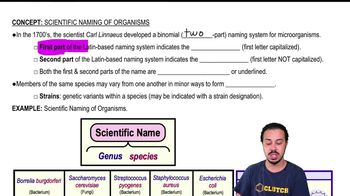
Scientific Naming of Organisms

Characteristics of Multicellular Animals

Multicellular animals typically have specialized tissues and organs, including a mouth for ingestion. Recognizing these features helps distinguish animals from other groups like fungi or plants, which lack a mouth and have different modes of nutrient acquisition.
Video consigliato:
05:09
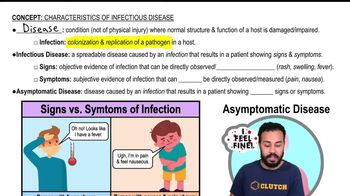
Intro to Characteristics of Infectious Disease

Parasitism and Host Interaction

Parasitic organisms live inside or on a host, often causing harm. Knowing that some multicellular animals can be parasites, such as those inhabiting human organs like the liver, aids in correctly classifying the organism based on its ecological role and habitat.
Video consigliato:
03:12
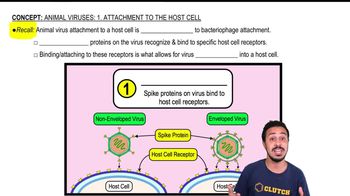
Animal Viruses: 1. Attachment to the Host Cell
Pratica correlata
Domanda del libro di testo

Use the following choices to answer questions 7 and 8.

a. Animalia

b. Fungi

c. Plantae

d. Bacillota (gram-positive bacteria)

e. Pseudomonadota (gram-negative bacteria)

Into which group would you place a photosynthetic organism that lacks a nucleus and has a thin peptidoglycan wall surrounded by an outer membrane?

1464
views
Domanda del libro di testo

The wall-less mycoplasmas are considered to be related to gram-positive bacteria. Which of the following would provide the most compelling evidence for this?

a. They share common rRNA sequences.

b. Some gram-positive bacteria and some mycoplasmas produce catalase.

c. Both groups are prokaryotic.

d. Some gram-positive bacteria and some mycoplasmas have coccus-shaped cells.

e. Both groups contain human pathogens.

1539
views
Domanda del libro di testo

Use the key in the Clinical Focus box to identify the gram-negative, oxidase-positive rod causing pneumonia in a sea otter. It is H2S-positive, indole-negative, and urease-positive.

1452
views
Domanda del libro di testo

You could identify an unknown bacterium by all of the following except

a. hybridizing a DNA probe from a known bacterium with the unknown’s DNA.

b. making a fatty acid profile of the unknown.

c. specific antiserum agglutinating the unknown.

d. ribosomal RNA sequencing.

e. percentage of guanine + cytosine.

1599
views
Domanda del libro di testo

Use the following choices to answer questions 9 and 10.

1. 9 + 2 flagella

2. 70s ribosome

3. fimbria

4. nucleus

5. peptidoglycan

6. plasma membrane

Which is (are) found in all three domains?

a. 2,6

b. 5

c. 2,4,6

d. 1,3,5

e. all six

901
views
Domanda del libro di testo

Use the information in the following table to complete the dichotomous key to these organisms. What is the purpose of a dichotomous key? Look up each genus in Chapter 11, and provide an example of why this organism is of interest to humans.

1503
views