

Ch. 11 - The Prokaryotes: Domains Bacteria and Archaea
Tortora - Microbiology: An Introduction 14th Edition
Tortora14th EditionMicrobiology: An IntroductionISBN: 9780138200398Non è quello che usi tu?Cambia libro di testo
Capitolo 7, Problema 8

Spirillum is not classified as a spirochete because spirochetes
a. do not cause disease.
b. possess axial filaments.
c. possess flagella.
d. are prokaryotes.
e. none of the above

Guida verificata passo dopo passo
1
Step 1: Understand the key terms in the question. 'Spirillum' and 'spirochetes' are both types of spiral-shaped bacteria, but they differ in certain structural features.
Step 2: Recall that spirochetes are characterized by the presence of axial filaments (also called endoflagella), which are flagella located in the periplasmic space that allow them to move in a corkscrew motion.
Step 3: Recognize that Spirillum bacteria have external flagella rather than axial filaments, which is a major reason they are not classified as spirochetes.
Step 4: Evaluate each answer choice in the context of these structural differences: (a) disease causation is not a defining feature, (b) possession of axial filaments is unique to spirochetes, (c) possession of flagella is common to many bacteria including spirilla, (d) being prokaryotes applies to both groups, and (e) none of the above.
Step 5: Conclude that the correct distinguishing feature is the possession of axial filaments by spirochetes, which Spirillum lacks.

Risposta video verificata per un problema simile:

Questa soluzione video è stata consigliata dai nostri tutor come utile per risolvere questo problema.

Concetti chiave

Ecco i concetti essenziali che devi comprendere per rispondere correttamente alla domanda.

Differences Between Spirillum and Spirochetes

Spirillum and spirochetes are both spiral-shaped bacteria, but they differ in structure and motility. Spirilla have external flagella for movement, while spirochetes move using internal axial filaments, which are unique to their morphology.
Video consigliato:
05:32
Reviewing the Different Types of Microscopes

Axial Filaments in Spirochetes

Axial filaments, also called endoflagella, are specialized structures located between the cell wall and outer membrane of spirochetes. These filaments enable a corkscrew-like motion, allowing spirochetes to move efficiently through viscous environments.
Video consigliato:
04:18
Bacteriophage: Filamentous Phage Infections

Flagella in Bacterial Motility

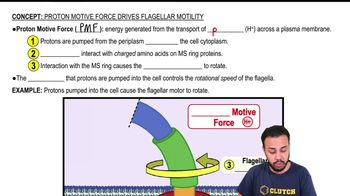
Flagella are whip-like appendages that extend outside the cell and facilitate bacterial movement. In spirilla, flagella are external and rotate to propel the cell, contrasting with the internal axial filaments of spirochetes.
Video consigliato:
04:17
Proton Motive Force Drives Flagellar Motility