Define symbiosis. Differentiate commensalism, mutualism, and parasitism, and give an example of each.
Ch. 14 - Principles of Disease and Epidemiology

Tortora14th EditionMicrobiology: An IntroductionISBN: 9780138200398Non è quello che usi tu?Cambia libro di testo
Capitolo 10, Problema 1
Differentiate the terms in each of the following pairs:
a. Etiology and pathogenesis
b. Infection and disease
c. Communicable disease and noncommunicable disease
Guida verificata passo dopo passo1
Step 1: Define 'etiology' as the study of the cause or origin of a disease, focusing on identifying the specific agent or factors responsible for the disease. Define 'pathogenesis' as the process by which the disease develops and progresses in the host, including the mechanisms of tissue damage and clinical manifestations.
Step 2: Define 'infection' as the invasion and multiplication of microorganisms such as bacteria, viruses, or parasites within the host's body. Define 'disease' as the condition that results when the infection causes damage or dysfunction in the host, leading to symptoms and signs.
Step 3: Define 'communicable disease' as an illness that can be transmitted from one person to another, either directly or indirectly, through various modes such as contact, droplets, or vectors. Define 'noncommunicable disease' as a disease that is not transmitted between people, often caused by genetic, environmental, or lifestyle factors.
Step 4: For each pair, highlight the key difference: etiology focuses on cause, pathogenesis on development; infection is presence of microbes, disease is the harmful effect; communicable diseases spread between hosts, noncommunicable do not.
Step 5: Summarize by providing examples for each term to reinforce understanding, such as tuberculosis for communicable disease and diabetes for noncommunicable disease.

Risposta video verificata per un problema simile:
Questa soluzione video è stata consigliata dai nostri tutor come utile per risolvere questo problema.
Durata del video:
3mConcetti chiave
Ecco i concetti essenziali che devi comprendere per rispondere correttamente alla domanda.
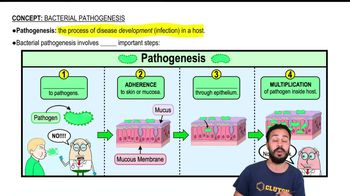
Etiology and Pathogenesis
Etiology refers to the study of the cause or origin of a disease, identifying the specific agent or factors responsible. Pathogenesis describes the mechanism by which the disease develops and progresses in the host, including the biological and physiological changes that occur.
Video consigliato:
Intro to Bacterial Pathogenesis
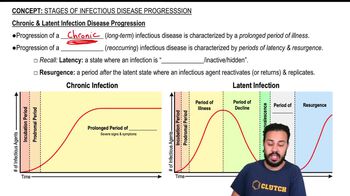
Infection and Disease
Infection is the invasion and multiplication of microorganisms such as bacteria, viruses, or fungi within the body. Disease occurs when the infection causes damage or dysfunction in the host, leading to symptoms and clinical signs.
Video consigliato:
Chronic & Latent Infection Disease Progression
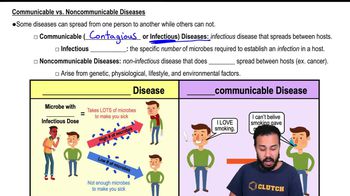
Communicable Disease and Noncommunicable Disease
Communicable diseases are illnesses that can be transmitted from one person to another, directly or indirectly, often caused by infectious agents. Noncommunicable diseases are not spread between people and usually result from genetic, lifestyle, or environmental factors.
Video consigliato:
Communicable vs. Noncommunicable Diseases
Pratica correlata
Domanda del libro di testo
1760
views
Domanda del libro di testo
All members of a group of ornithologists studying barn owls in the wild have had
salmonellosis (Salmonella gastroenteritis). One birder is experiencing her third infection. What is the most likely source of their infections?
a. The ornithologists are eating the same food.
b. They are contaminating their hands while handling the owls and nests.
c. One of the workers is a Salmonella carrier.
d. Their drinking water is contaminated.
1161
views
Domanda del libro di testo
The emergence of new infectious diseases is probably due to all of the following except:
a. The need of bacteria to cause disease
b. The ability of humans to travel by air
c. Changing environments (e.g., flood, drought, pollution)
d. A pathogen crossing the species barrier
e. The increasing human population
1351
views