
Ch. 25 - Microbial Diseases of the Digestive System
Tortora - Microbiology: An Introduction 14th Edition
Tortora14th EditionMicrobiology: An IntroductionISBN: 9780138200398Non è quello che usi tu?Cambia libro di testo
Capitolo 21, Problema 9

Use the following choices to answer the following question:
a. Campylobacter
b. Cryptosporidium
c. Escherichia
d. Salmonella
e. Trichinella


Microscopic observation of a stool sample reveals gram-negative helical cells.

Guida verificata passo dopo passo
1
Step 1: Identify the key characteristics described in the problem. Here, the stool sample shows gram-negative helical cells under microscopic observation.
Step 2: Recall the general morphology and gram-staining properties of the organisms listed: Campylobacter, Cryptosporidium, Escherichia, Salmonella, and Trichinella.
Step 3: Note that Campylobacter is known to be a gram-negative, curved or helical-shaped bacterium, which matches the description of gram-negative helical cells.
Step 4: Recognize that Cryptosporidium is a protozoan, Escherichia and Salmonella are gram-negative rods (not helical), and Trichinella is a parasitic worm, so they do not fit the description of gram-negative helical cells.
Step 5: Conclude that the organism observed is most consistent with Campylobacter based on its gram-negative and helical morphology.

Risposta video verificata per un problema simile:

Questa soluzione video è stata consigliata dai nostri tutor come utile per risolvere questo problema.

Concetti chiave

Ecco i concetti essenziali che devi comprendere per rispondere correttamente alla domanda.

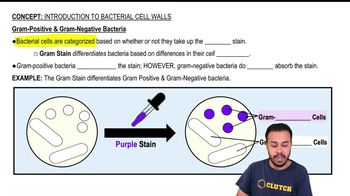
Gram-negative Bacteria

Gram-negative bacteria have a thin peptidoglycan layer and an outer membrane containing lipopolysaccharides, which causes them to stain pink in the Gram stain procedure. This structural feature affects their pathogenicity and antibiotic resistance.
Video consigliato:
02:20
Gram-Positive & Gram-Negative Bacteria

Helical Bacterial Morphology

Helical bacteria have a spiral or curved rod shape, which can influence their motility and colonization abilities. Examples include Campylobacter and Helicobacter, which are often associated with gastrointestinal infections.
Video consigliato:
02:44
Types of Bacterial Cell Morphology

Identification of Pathogens in Stool Samples

Microscopic examination of stool samples helps identify pathogens based on morphology and staining. Recognizing gram-negative helical cells narrows down possible causative agents, aiding in diagnosis and treatment decisions.
Video consigliato:
03:40
Introduction to Pathogenic Toxins