Ch. 7 - The Control of Microbial Growth
Tortora - Microbiology: An Introduction 14th Edition
Tortora14th EditionMicrobiology: An IntroductionISBN: 9780138200398Non è quello che usi tu?Cambia libro di testo
Capitolo 4, Problema 9

You and your classmates are trying to determine how a disinfectant might kill cells. You observe that when you spill the disinfectant in a tube of reduced litmus milk, the litmus turns blue again. You suggest to your classmates that:
a. The disinfectant might inhibit cell wall synthesis
b. The disinfectant might oxidize molecules
c. The disinfectant might inhibit protein synthesis
d. The disinfectant might denature proteins
e. The disinfectant might damage DNA

Guida verificata passo dopo passo
1
Step 1: Understand the role of litmus milk in microbiology. Litmus milk contains litmus, a pH indicator that changes color depending on the chemical environment, and milk proteins that can be metabolized by bacteria.
Step 2: Recognize that reduced litmus milk appears white or colorless because the litmus indicator is in a reduced (electron-rich) state, often due to bacterial metabolic activity under anaerobic conditions.
Step 3: Observe that when the disinfectant is added, the litmus turns blue again, indicating that the environment has become oxidized (electron-poor), reversing the reduction of the litmus indicator.
Step 4: Connect the color change to the chemical action of the disinfectant. Since the litmus turns blue (oxidized), the disinfectant likely causes oxidation of molecules in the medium.
Step 5: Conclude that among the options, the disinfectant's effect is best explained by its ability to oxidize molecules, which corresponds to option (b).

Risposta video verificata per un problema simile:

Questa soluzione video è stata consigliata dai nostri tutor come utile per risolvere questo problema.
Durata del video:
2m

Concetti chiave

Ecco i concetti essenziali che devi comprendere per rispondere correttamente alla domanda.

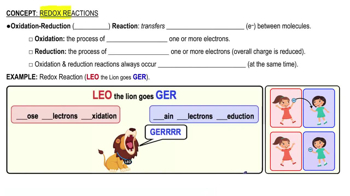
Redox Reactions and Litmus Indicator

Litmus milk contains litmus, a pH and redox indicator that changes color based on oxidation-reduction reactions. Reduced litmus appears white or colorless, while oxidized litmus is blue or purple. Observing litmus turning blue indicates oxidation, meaning the disinfectant likely acts as an oxidizing agent.
Video consigliato:
04:46
Redox Reactions

Mechanisms of Disinfectant Action

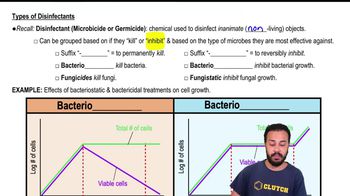
Disinfectants kill microbes through various mechanisms such as inhibiting cell wall synthesis, denaturing proteins, damaging DNA, or oxidizing cellular components. Understanding these mechanisms helps identify how a disinfectant affects microbial cells and which cellular targets are involved.
Video consigliato:
05:21
Types of Disinfectants

Protein Denaturation vs. Oxidation

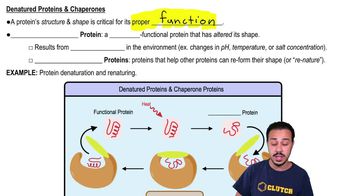
Protein denaturation involves disrupting protein structure without necessarily changing redox states, while oxidation chemically alters molecules by removing electrons. Since litmus color change indicates oxidation, the disinfectant likely oxidizes molecules rather than just denaturing proteins.
Video consigliato:
04:00
Denatured Proteins & Chaperones